
close
Choose Your Site
Global
Social Media


Views: 0 Author: Site Editor Publish Time: 2026-05-11 Origin: Site


The DC/DC converter acts as the "alternator of the EV." It manages the vital step-down from the high-voltage traction battery to the low-voltage auxiliary network. This low-voltage bus powers critical systems like HVAC, power steering, air compressors, and telematics. Without reliable power delivery, the entire vehicle comes to an abrupt halt.
For heavy-duty applications, choosing a 12kW DC/DC capacity represents a highly pragmatic sweet spot. It provides sufficient power for demanding commercial loads. Simultaneously, it avoids the severe weight and cost penalties of unnecessary 20kW+ over-engineering. Electric fleet operators demand efficiency and reliability above all else.
Our goal is to provide procurement managers and system architects with an evidence-based framework. You will learn how to evaluate and select the right converter unit. We base this framework on proven efficiency, advanced thermal management, and robust electrical resilience.
Right-Sizing Trumps Redundancy: A 12kW capacity aligns with actual continuous commercial loads, avoiding the industry pitfall of highly oversized (and under-utilized) power modules.
Efficiency Drives ROI: Prioritize units utilizing synchronous rectification (MOSFETs) to achieve ≥92%–94% efficiency, drastically reducing waste heat and extending traction battery range.
Environmental Survival is Non-Negotiable: Commercial truck deployments require strict adherence to automotive-grade protections, including IP6K9K sealing, planar magnetics for extreme heat, and robust load-dump transient defense.
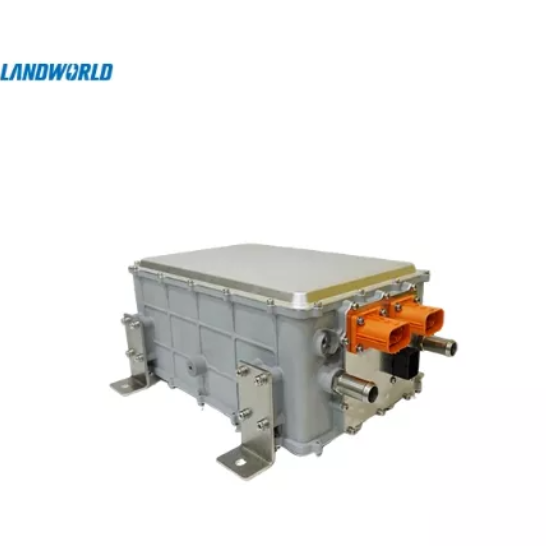
System architects frequently face a dilemma when specifying power requirements for modern commercial vehicles. They must balance adequate power reserves against the physical constraints of the vehicle chassis. Understanding exact load requirements prevents poor design choices.
Many hardware integrators fall into a common industry misstep. They specify excessively large converters. We frequently see 180A+ rated units chosen to support edge-case bidirectional capabilities. Standard accessory loads rarely justify this added weight and bulk. Over-engineering leads to under-utilized power modules operating outside their optimal efficiency bands. When you use a massive 20kW converter to drive a steady 6kW load, the unit operates inefficiently. This wastes battery energy as unnecessary heat.
A continuous 12kW output perfectly supports the heavy-duty auxiliary ecosystems found in modern electric trucks. Let us examine the actual continuous power draw of a typical commercial chassis:
Electric Power Steering (EPS): Requires 1.5kW to 2kW during low-speed maneuvers.
Airbrake Compressors: Draw up to 3kW during pressure building cycles.
Cabin Climate Control (HVAC): Consumes roughly 2kW to 4kW depending on ambient conditions.
Coolant Pumps and Fans: Demand 1kW to 1.5kW for battery thermal management.
Telematics and ECUs: Use around 500W continuously.
When combined, these systems demand between 8kW and 10kW during peak concurrent operation. A 12kW capacity leaves a safe, conservative margin without bloated excess.
In traditional internal combustion engine (ICE) vehicles, the belt-driven alternator suffers from terrible efficiency. Legacy alternators often peak at just 50% to 60% efficiency. Because ICE platforms generate massive amounts of waste heat naturally, engineers historically ignored this parasitic loss.
Electric platforms operate differently. The main electric drive-chain easily achieves 85% to 90%+ efficiency. In a battery-only system, high conversion losses are completely unacceptable. Every watt wasted by an inefficient DC/DC Converter for commercial EV applications directly reduces vehicle range. You cannot afford to lose precious kilowatt-hours simply stepping down the voltage.
Component Type | Power Source | Average Efficiency | Primary Byproduct |
|---|---|---|---|
Legacy Alternator | Combustion Engine Belt | 50% - 60% | High mechanical drag and extreme heat |
Standard EV DC/DC | High-Voltage Battery | 85% - 88% | Moderate thermal dissipation |
High-Efficiency EV DC/DC | High-Voltage Battery | 92% - 95% | Minimal heat, requires optimized cooling |
Specifying a high-performance converter requires looking inside the external casing. The internal circuit topology dictates how well the device will perform under heavy commercial strain.
Older power module designs rely on standard Schottky diodes for rectification. Diodes act as one-way valves for electrical current. However, they carry a steep penalty: a fixed forward voltage drop. A typical diode drops about 1.2V. If your system pushes 50A of current through that diode, the power loss equals 60 watts (50A x 1.2V). This creates massive localized heat.
To push efficiency past the 92% threshold, a modern 12kW high-efficiency DC/DC Converter replaces diodes with synchronous rectification. This method uses low-RDS(on) MOSFETs. A specialized MOSFET acts like an electronically controlled switch with minimal resistance. Instead of a 1.2V drop, the MOSFET might only drop 0.1V. At 50A, the power loss plummets from 60W to just 5W. This quantitative reduction in waste heat drastically extends traction battery range.
Power electronics engineers face a constant battle balancing three competing forces. We call this the impossible triangle of power design. You must evaluate how the manufacturer managed these trade-offs.
Design Parameter | Benefit if Increased | Negative Trade-off (The Penalty) |
|---|---|---|
Switching Frequency | Allows for much smaller inductors and capacitors, shrinking device size. | Generates severe high-frequency EMI noise; increases switching losses. |
Physical Footprint | Easier integration into cramped vehicle chassis spaces. | Reduces surface area for heat dissipation; requires complex liquid cooling. |
EMI Suppression | Protects sensitive telematics and autonomous sensors from signal interference. | Requires heavy, bulky shielding and large external filter components. |
Higher switching frequencies allow engineers to use smaller magnetic components. This reduces the physical footprint. However, rapid switching generates severe electromagnetic interference (EMI). The manufacturer must implement sophisticated PCB layouts and metal shielding to mitigate high-frequency RF interference. A compact unit failing to suppress EMI will disrupt vehicle sensor networks.
You must also assess the primary conversion structure. Voltage-sourced H-bridge designs dominate the market because they are simpler to manufacture. They utilize straightforward control algorithms. Conversely, current-fed topologies feature a series choke on the input side. This design offers superior fault tolerance. It inherently resists short circuits and provides excellent ripple rejection. The penalty lies in control complexity. Current-fed systems demand highly advanced microcontrollers to maintain stable operation.
Commercial trucks operate in brutal environments. A converter sitting in a climate-controlled lab behaves very differently than one mounted to a vibrating truck frame in freezing rain.
Commercial truck electrical networks are notoriously hostile. Large inductive loads like motors, pumps, and solenoids switch on and off constantly. This switching creates aggressive voltage spikes. The most severe event is the "load dump." A load dump occurs when a battery disconnects while the alternator or generator is actively pushing high current.
During a load dump, transient voltages can spike above 60V in mere milliseconds on a standard 24V bus. If the converter lacks robust Over-Voltage Protection (OVP), this spike will instantly obliterate the internal silicon. You must demand compliance with strict automotive transient standards like ISO 16750-2. The unit must absorb these massive energy spikes without interrupting auxiliary power.
Heat kills power electronics. In high-power applications, standard air cooling fails completely. You need advanced thermal management pathways. Traditional transformers use bulky copper wire wrapped around a heavy ferrite core. They trap heat deep inside the windings.
Modern commercial units utilize planar magnetics. Planar transformers replace wire windings with flat copper lead frames or specialized printed circuit boards. This flat profile provides a massive surface area. It reduces leakage inductance. Most importantly, it allows direct physical contact with liquid cooling plates. Direct contact is essential for surviving the extreme 105°C ambient coolant loops commonly found in heavy-duty battery management systems.
Water, salt, and vibration destroy poorly sealed electronics. You must establish IP67 or IP6K9K as the absolute baseline for any DC/DC Converter for Electric Trucks. IP6K9K certification guarantees the unit can withstand high-pressure, high-temperature steam washing. It ensures the internal circuitry survives exposure to winter road salt and harsh degreasing chemicals. Furthermore, heavy truck frames experience extreme low-frequency vibrations. The converter's internal PCB must feature conformal coating and heavy-duty potting compounds to prevent solder joint fractures over time.
A power module cannot operate in isolation. It must safely bridge the gap between volatile high-voltage battery packs and highly sensitive low-voltage microprocessors.
Never install a non-isolated converter in a high-voltage EV application. Full electrical isolation is completely mandatory in heavy-duty electric trucks. Galvanic isolation uses a high-frequency transformer to transfer energy magnetically, rather than through a direct physical wire connection.
If a catastrophic failure occurs inside the high-voltage traction system (e.g., a 800V short circuit), galvanic isolation acts as a physical firewall. It prevents high-voltage catastrophic surges from crossing over and frying the 12V/24V electronic control units (ECUs). It protects the sensitive telematics and safeguards human operators interacting with low-voltage cabin controls.
The industry has shifted entirely away from sluggish analog control loops. We now rely on pure digital control algorithms. A commercial-grade 12kW DC/DC unit must integrate seamlessly with the vehicle's central CAN bus network (often using the J1939 protocol for heavy trucks).
Digital integration allows for precision voltage regulation. The vehicle master controller can dynamically adjust the converter's output voltage based on ambient temperature or battery state-of-charge. Furthermore, digital control enables fault reporting and smart derating. Instead of executing a sudden, hard thermal shutdown when temperatures peak, a smart unit communicates the thermal stress to the vehicle network. It then safely scales back its power output, keeping essential steering and braking systems online while reducing heat generation.
Scalability matters for growing fleets. You might specify a 12kW unit today, but a future chassis upfit (like adding an electric refrigeration unit) might demand 24kW. The chosen converter should support synchronized parallel operation.
Parallel operation requires active current sharing logic. If you wire two converters together without smart load sharing, they will fight each other. One unit will bear the entire electrical burden until it overheats, while the other sits idle. Destructive cross-currents can occur. Ensure your selected device supports active CAN-based paralleling to distribute heavy loads perfectly across multiple modules.
Procuring hardware for commercial fleets demands rigorous vetting. Marketing brochures often highlight ideal laboratory conditions that never reflect reality.
Verify exactly what the "12kW" label means. Some manufacturers label a 9kW continuous unit as "12kW Peak" to boost sales. You must verify the 12kW rating represents a continuous operational baseline. Additionally, the unit must possess a verified 25-30% peak margin. Air compressors and large cooling fans create massive inrush currents upon startup. The converter must supply this sudden 15kW surge for a few seconds without tripping its Over-Current Protection (OCP) circuits.
Instruct your buying team to look past top-line marketing efficiency numbers. A manufacturer claiming "Up to 95% efficiency" might only achieve that at a specific 40% load in a 25°C room. Demand comprehensive documentation.
Request efficiency curves detailing performance at 20%, 50%, and 100% loads across varying temperatures. A truly robust device maintains tight efficiency curves even at 85°C. Furthermore, demand formal EMI compliance reports proving the device passes CISPR 25 standards for radiated and conducted emissions.
Before issuing a purchase order, finalize these practical integration steps:
Confirm input and output voltage windows exactly match your specific traction battery chemistry. A 400V architecture behaves very differently from an 800V architecture during low-state-of-charge conditions.
Validate automotive-grade certifications (such as AEC-Q100 for internal silicon) and assess the manufacturer's engineering integration support.
Assess the physical mounting footprint against available chassis real estate. Confirm the liquid coolant loop routing aligns with the vehicle's existing plumbing infrastructure.
Selecting a 12kW DC/DC converter requires carefully balancing high-efficiency power delivery with rugged, automotive-grade transient protection. You cannot compromise on physical durability or thermal management when building commercial vehicles.
Avoid specifying oversized, heavy 20kW+ modules for standard 10kW loads. Instead, focus on finding optimized 12kW units built upon proven topologies. Prioritize planar thermal management, synchronous rectification, and strict galvanic isolation. By enforcing these strict procurement standards, fleet operators can ensure their electric trucks maintain maximum uptime, exceptional auxiliary reliability, and optimized battery range in the field.
A: Check the manufacturer's datasheet for a detailed efficiency curve chart rather than trusting a single "up to" number. Look closely at performance metrics recorded at typical operating temperatures (like 65°C to 85°C), not just ideal laboratory conditions. Efficiency should ideally remain stable across the 50% to 100% load spectrum.
A: Yes. For any high-voltage traction battery application, galvanic isolation is a critical safety requirement. It separates the dangerous primary voltage from the low-voltage passenger cabin electronics. This prevents lethal voltage cross-over during catastrophic failures and eliminates severe ground-loop noise coupling.
A: Yes, if the smaller converters explicitly support active "load sharing" via CAN bus communication. However, a single, correctly sized 12kW unit typically offers a lower overall footprint, fewer failure points, and much simpler liquid coolant loop integration.


