
close
Choose Your Site
Global
Social Media


Views: 0 Author: Site Editor Publish Time: 2026-05-04 Origin: Site


Transitioning commercial electric vehicles to 400V or 800V architectures introduces immense auxiliary power demands. Heavy-duty trucks, transit buses, and construction equipment require massive energy pools. Standard passenger-vehicle converters simply cannot cope. These smaller 2kW to 4kW units fail under continuous high-wattage loads. Commercial subsystems quickly overwhelm them. A dedicated 12kW converter bridges this critical gap. It safely connects high-voltage traction batteries to essential low-voltage networks. This ensures reliable power distribution and optimal thermal management. It achieves these goals without adding unnecessary vehicle weight. In this article, you will discover the engineering fundamentals behind high-capacity power conversion. We will explore thermal management trade-offs, functional safety standards, and integration strategies. You will learn how to select the right components for your fleet. Ultimately, this guide provides the technical clarity needed to build robust, road-ready commercial platforms.
Load Capacity: A 12kW DC/DC converter safely manages heavy commercial auxiliary loads (HVAC, air compressors, advanced ADAS) without risking voltage drops.
System-Level Efficiency: Leveraging wide-bandgap semiconductors (SiC/GaN) enables >95% peak efficiency, reducing thermal waste and directly extending commercial fleet range.
Weight & Packaging: High-power density architectures allow for the elimination of traditional heavy lead-acid auxiliary batteries ("de-leading").
Safety Compliance: Enterprise-grade converters strictly adhere to ISO 26262 (ASIL ratings) to guarantee isolation and redundancy for safety-critical systems like electronic power steering.
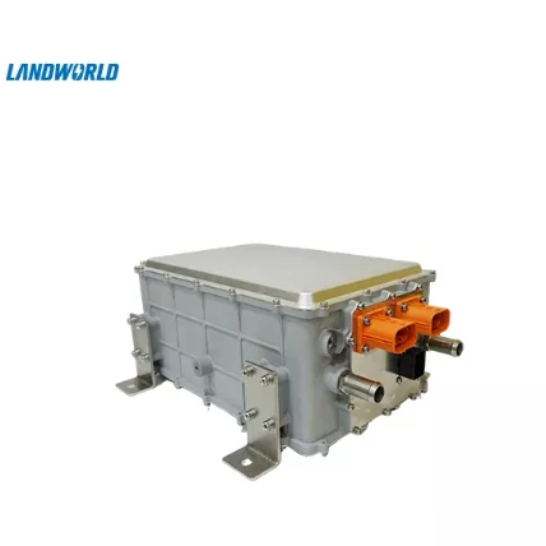
Commercial vehicle subsystems operate under a harsh mathematical reality. Heavy-duty electric HVAC units routinely draw up to 5kW. Pneumatic braking compressors require another 3kW during active cycles. Hydraulic liftgates, complex telematics, and high-power lighting demand an additional 2kW. Simultaneous operation of these components easily exceeds 8kW to 10kW peak demands. Passenger cars never experience this sustained energy draw. You cannot rely on light-duty electronics for heavy-duty tasks. A robust 12kW unit provides the necessary headroom. It keeps essential systems running smoothly under maximum stress.
Many engineers initially attempt to daisy-chain multiple lower-wattage converters. This approach introduces severe architectural risks. Linking three 4kW units triples the physical footprint. It requires complex load-sharing software. It dramatically increases wire harness weight. Every additional housing adds another potential point of failure. Multiple switching frequencies compound electromagnetic interference (EMI) issues. Implementing a singular, high-capacity DC/DC Converter for commercial EV applications eliminates these redundant headaches. It centralizes power management into one reliable node.
Commercial fleets experience drastic load fluctuations continuously. A delivery truck might idle at a sub-kilowatt state. Moments later, it engages air compressors and cooling fans simultaneously. This creates a sudden 10kW surge. Inferior power supplies stumble during these transitions. They induce dangerous voltage ripples across the low-voltage network. These ripples can reset sensitive ADAS sensors or electronic control units (ECUs). High-quality converters absorb these massive transients. They maintain a flat, stable output regardless of sudden input demands.
Modern electrical conversion relies on advanced semiconductor technology. Resonant LLC topologies allow for Zero Voltage Switching (ZVS). This technique drastically minimizes switching losses inside the unit. Silicon Carbide (SiC) MOSFETs take this performance further. They switch at incredibly high frequencies while generating minimal heat. You should expect 95% to 98% peak efficiency depending on specific load profiles. Always avoid vendors claiming "lossless" conversion. Physics dictates some energy loss. However, pushing efficiency above 95% represents a massive engineering triumph for heavy vehicles.
Electrical efficiency directly impacts thermal load. High efficiency means less rejected heat. A unit operating at 96% efficiency under a 10kW load only wastes 400 watts as heat. A less efficient 90% unit wastes 1,000 watts. This difference changes your entire thermal management strategy. Lower heat output allows engineers to specify smaller liquid-cooling loops. Sometimes they can rely entirely on advanced conduction cooling. This shrinks the overall system footprint. It saves critical space inside crowded commercial chassis designs.
Traditional trucks carry massive 12V or 24V lead-acid batteries. These batteries run auxiliary systems when the engine is off. Electric architectures render these heavy batteries obsolete. A reliable 12kW high-efficiency DC/DC Converter acts as an active power router. It pulls energy directly from the massive traction battery. OEMs can safely remove or heavily downsize lead-acid components. This process is called "de-leading". It nets significant vehicle weight reductions. Furthermore, it eliminates a major maintenance failure point for fleet operators.
Battery voltages fluctuate significantly depending on their state of charge. A 400V architecture might drop to 320V when nearly empty. It might peak at 450V during regenerative braking. The converter must handle these wide input variations seamlessly. It must continuously deliver a highly stable 24V or 48V output. You must verify the permissible input voltage window before selecting a component. Narrow input windows lead to premature system shutdowns during extreme driving conditions.
Procurement and engineering teams must calculate total continuous subsystem wattage carefully. Follow the industry-standard redundancy rule. Here is how you apply it:
List every low-voltage component on the commercial vehicle.
Determine the peak continuous wattage for each component.
Sum these values to find the maximum theoretical load.
Multiply this final number by 1.25.
This provides a 25% safety margin. It prevents thermal throttling during peak operational conditions. It ensures the converter never operates at absolute maximum capacity for extended periods.
Space remains a premium commodity even in large commercial vehicles. Engineers must evaluate power density. This is measured in watts per cubic centimeter (W/cm³). Establish high baseline expectations for physical packaging. Emphasize surface-mount designs. Look for dual-sided cooling configurations. These designs fit within tight commercial chassis constraints. Bulky converters force awkward mounting locations. Compact, power-dense units offer flexible integration options.
Heavy-duty applications punish electronic components. Standard automotive ratings often fall short. Commercial converters require extreme environmental robustness.
Dust and Water: Demand IP67 or IP6K9K ratings. These protect against high-pressure water ingress and fine dust.
Vibration: Commercial chassis vibrate violently. The unit must pass extreme shock tolerances.
Temperature: Operating ranges should span from -40°C to 85°C.
Converter Evaluation Matrix
Evaluation Criteria | Standard Passenger EV Specs | Commercial EV Requirements |
|---|---|---|
Continuous Power | 2kW - 4kW | 10kW - 12kW |
Redundancy Margin | 1.10x | 1.25x (Crucial for heavy loads) |
Ingress Protection | IP65 / IP67 | IP6K9K (High-pressure washdown) |
Output Voltage | 12V strictly | 24V or 48V dynamic options |

High-voltage traction domains carry lethal energy. The low-voltage user domain powers dashboard screens and cabin lights. You must maintain strict physical electrical separation between these two networks. This is called galvanic isolation. It utilizes high-frequency transformers to pass energy magnetically. It prevents high-voltage spikes from jumping into the 24V system. Without this isolation, an internal fault could cause a catastrophic arc flash. It would instantly destroy all low-voltage electronics on the vehicle.
Commercial deployment makes automotive safety compliance non-negotiable. ISO 26262 is the international standard for functional safety in road vehicles. Subsystems receive Automotive Safety Integrity Level (ASIL) ratings. Electronic power steering and pneumatic braking rely on the converter. Therefore, the converter must meet ASIL-C or ASIL-D standards. These ratings mandate strict hardware redundancy. They ensure fail-safe operations if internal logic controllers malfunction. Do not integrate unrated converters into heavy-duty platforms.
High-power switching at 12kW generates massive electromagnetic interference (EMI). Wide-bandgap semiconductors switch incredibly fast. This speed creates high-frequency noise. This noise can disrupt radio communications, GPS, and telematics. You must address these electromagnetic compatibility (EMC) challenges early. Look for active EMI filtering inside the unit. Ensure the manufacturer uses shielded enclosures. The entire package must comply with the automotive standard CISPR 25. Proper grounding techniques are essential during physical installation.
Modern power electronics must protect themselves. You cannot rely solely on external fuses. Required diagnostic features include:
Over-Voltage Protection (OVP): Shuts down if input spikes dangerously high.
Over-Current Protection (OCP): Limits energy flow if a subsystem draws too much power.
Short-Circuit Protection (SCP): Instantly cuts power if wiring harnesses chafe and short.
Predictive Thermal Shutdown: Gradually reduces power output as internal temperatures near critical limits.
Best Practices: Always map these automated protections into your Vehicle Control Unit (VCU) software. Ensure the VCU alerts the driver before a thermal shutdown occurs.
Common Mistakes: Ignoring fault codes during testing. If a converter triggers OCP repeatedly, your auxiliary load calculations are likely incorrect.
Vehicle communication protocols are complex. Hardware cannot function in isolation. Converters must seamlessly handshake with the Vehicle Control Unit (VCU). They communicate via standard protocols like CAN 2.0B or J1939. This link provides real-time load monitoring. It allows the VCU to adjust output voltages dynamically. It also enables Over-The-Air (OTA) software updates. Firmware bugs often cause integration friction. Work closely with vendor software teams during initial setup. Verify all CAN message identifiers align properly.
Procurement teams face strict topology choices. Adopting a premium 1200V SiC-MOSFET solution offers maximum efficiency. It shrinks the cooling requirements. However, it requires a higher upfront component investment. Alternatively, engineers might choose paralleled 650V Si-MOSFET designs. This approach lowers upfront part expenses. It does require strict Rds(on) resistance management. Paralleled standard silicon often generates more heat under heavy loads. You must balance the physical component cost against the added weight of larger cooling systems.
Topology Performance Chart
Topology Architecture | Peak Efficiency | Thermal Output | Engineering Complexity |
|---|---|---|---|
1200V SiC-MOSFET | 97% - 98% | Very Low | Moderate |
Paralleled 650V Si-MOSFET | 93% - 95% | Moderate to High | High (Current sharing) |
Standard IGBT | 88% - 91% | Very High | Low |
Moving from theory to production requires rigorous testing. You should mandate hardware-in-the-loop (HIL) testing early in the cycle. Request physical engineering samples from the vendor. Integrate the 12kW DC/DC unit into your bench test setup. Simulate extreme environmental temperatures. Review the full-load efficiency curves under continuous stress. Measure the actual CAN bus latency. Do not commit to volume production until the hardware proves its stability in simulated commercial conditions.
Summary of engineering value: A 12kW unit is not just a basic voltage step-down device. It is a critical enabler of commercial EV performance. It drives weight reduction and ensures system-level safety.
Final decision logic: Balance peak efficiency claims against your actual vehicle requirements. Factor in thermal integration complexity, software compatibility, and environmental ruggedness.
Actionable next step: Request full-load efficiency curves from potential vendors. Scrutinize their automotive safety certifications before starting your chassis integration phase.
Future proofing: Plan for 48V low-voltage architectures today. This prepares your fleet for higher-power ADAS and automated driving sensors tomorrow.
A: High-quality SiC-based models typically experience only 3% to 5% energy loss. This lost energy converts to heat under optimal loads. The exact efficiency curve shifts depending on operational temperatures and the current load percentage.
A: Yes. Many modern commercial converters output 48V. This supports lighter wiring harnesses and higher-power accessories. However, 24V remains extremely common in legacy commercial systems and most converters offer models for both voltage levels.
A: Most auxiliary 12kW DC/DC units are uni-directional. They only step down from high voltage to low voltage. Bi-directional capabilities are generally reserved for V2G (Vehicle-to-Grid) on-board chargers or active battery-balancing applications.


