
close
Choose Your Site
Global
Social Media


Views: 0 Author: Site Editor Publish Time: 2026-08-04 Origin: Site


You use an on-board battery charger to keep your batteries full and ready. This device takes AC power from a wall outlet and changes it to DC power, which your battery needs. The onboard battery charger stays fixed in your boat or vehicle after installation, so you do not have to move it around. You get automatic charging, which means you do not need to watch the process. This helps you protect your battery and save time.
On-board battery chargers change AC power into DC power. They keep your batteries charged and ready. You do not need to check them yourself.
Automatic charging features change how the charger works. They look at what the battery needs. This stops the battery from getting too full. It helps the battery last longer.
The charging process has three steps. Bulk charging fills the battery fast. Absorption charging tops off the battery. Float charging keeps the battery ready to use.
Safety features in on-board chargers keep things safe. They protect against too much voltage. They stop short circuits and overheating. This makes sure the charger works safely.
Pick a charger that works with your battery type and voltage. This helps your battery work well and stay healthy.
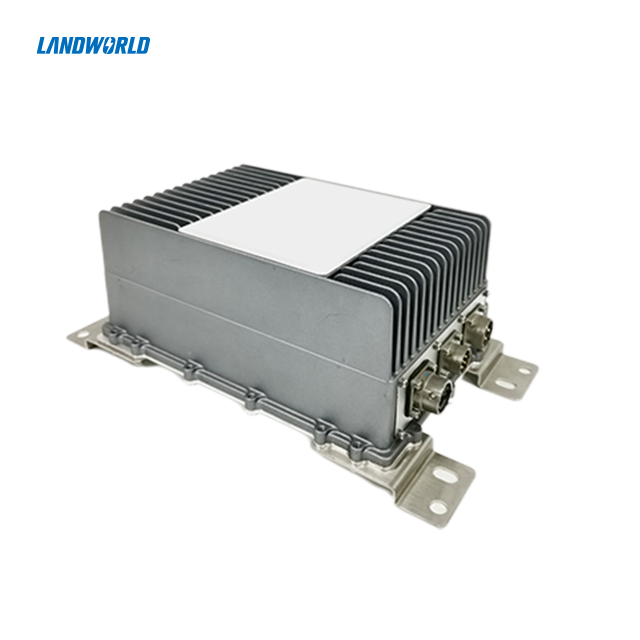
You use an on-board battery charger to change AC power from a wall into DC power for your batteries. This starts when you plug the charger into a power source, like shore power at a dock or a garage outlet. The charger has special electronic parts that make this change safe and work well.
Transformers lower the high AC power to a voltage your batteries can use.
Rectifiers turn the AC power into a bumpy DC signal.
Full-wave rectifying circuits help change AC voltage into DC voltage.
Capacitors smooth out the DC voltage, so your batteries get steady power.
Power factor correction circuits help the charger work better by fixing problems in the electric signal.
Onboard battery chargers work better than old chargers. The table below shows how different chargers compare:
Charger Type | Efficiency Comparison |
|---|---|
Onboard Chargers (OBCs) | Usually have higher efficiency because of new technology. |
Traditional Chargers | Not as efficient, and they lose more energy as heat. |
High-Frequency Chargers | Give better efficiency and more control over charging. |
This means you waste less energy. Your batteries charge faster and more reliably. You do not have to move the charger after you install it. It stays in your boat or vehicle, ready to use.
You get automatic charging with an onboard battery charger. The charger checks your batteries and changes how it charges to keep them healthy. It watches things like battery voltage, charging current, battery temperature, and how well the battery takes the charge. The charger also keeps track of how long each charging step takes.
Here is how the charger checks and reacts:
Parameter Monitored | Purpose |
|---|---|
Battery voltage | Checks how much charge is in the battery. |
Charging current | Watches the current to keep charging safe and efficient. |
Battery temperature | Changes charging to stop the battery from getting too hot. |
Charge acceptance rate | Sees how well the battery takes the charge. |
Time in each charging phase | Makes sure the battery charges right without overcharging. |
Adjustment Mechanism | Function |
|---|---|
Real-time parameter tuning | Changes charging settings as the battery needs. |
Temperature compensation | Adjusts charging if the temperature changes. |
Degradation detection | Finds battery wear and changes charging to help the battery last. |
Overcharge prevention | Stops the battery from getting too much charge. |
You do not need to watch the charger or guess when to stop charging. The charger uses automatic recharging to keep your batteries full without overcharging or overheating. This protects your batteries and helps them last longer.
Onboard battery chargers also have safety features to protect you and your equipment. These features include:
Over-voltage and under-voltage protection to stop dangerous voltage changes.
Short-circuit and reverse polarity protection to keep the charger safe if you connect it wrong.
Over-temperature shutdown to turn off the charger if it gets too hot.
Soft start and current limiting to stop sudden power surges.
Fuses and circuit breakers to stop damage from too much current.
Thermal protection to keep the charger and batteries from getting too hot.
You can relax because your onboard battery charger takes care of charging and safety for you.

You need to know how charging works to keep batteries healthy. On-board battery chargers use three steps to fill batteries safely. Each step has a special job and helps batteries last longer.
Tip: Using the right charging steps stops battery damage and saves money.
Here is a table that shows the three main steps and what they do:
Stage | Definition |
|---|---|
Bulk Charging (Constant Current) | Fills about 80% of the battery’s charge quickly using a steady, high current. |
Absorption Stage (Constant Voltage) | Tops off the last 20% of the charge at a steady voltage, with current slowly decreasing. |
Float Stage (Trickle Charge) | Keeps the battery full by sending a small current, so it stays ready without overcharging. |
The bulk stage comes first. This is the fastest step. The charger sends strong current into batteries. Voltage goes up as batteries fill. Most energy—about 80%—goes in during this step. Batteries charge quickly, so you can use them sooner.
The bulk stage uses the highest safe current.
Voltage for most batteries is 14.4 to 14.8 volts.
AGM or flooded batteries can reach 28.8 to 29.4 volts.
Battery Type | Voltage Range (V) | Current Range (A) |
|---|---|---|
Lead-Acid | 14.5 | Maximum allowable current |
AGM/Flooded | 28.8 to 29.4 | Up to 25% of battery capacity |
General | 14.4 to 14.8 | Constant current until target voltage reached |
Bulk charging puts the most energy into batteries. This step also helps batteries work better and gets you back on the water or road faster.
Next is the absorption stage. The charger keeps voltage steady and lowers the current. This step fills the last 20% of the battery’s charge. The absorption stage stops overcharging and keeps batteries from getting too hot.
The charger controls the current as the battery gets full. This gentle finish protects batteries from damage and helps them last longer. You do not need to worry about overcharging because the charger manages the process.
“The absorption stage is essential in the battery charging process as it ensures the battery achieves its full capacity without the risk of overcharging. During this stage, the voltage remains constant while the battery charges at a gradually decreasing rate, which optimizes the charging process and extends the battery's lifespan.”
The float stage is last. The charger keeps batteries full by sending a small, steady current. This step is also called trickle charging. The float stage makes sure batteries stay ready, even if you leave them connected for a long time.
You do not have to worry about overcharging. The charger only gives batteries the power they need to stay full. This is important for boats and vehicles that sit unused for days or weeks.
The float stage helps batteries stay healthy and ready when you need them. It also lowers the risk of battery failure and saves you from buying new batteries too soon.
“The float stage is a crucial part of the three-stage charging process, designed to keep the battery at a full charge without risking overcharging. This stage allows a small amount of current to flow into the battery, maintaining its charge safely over extended periods, which is essential for preserving battery health.”
By using these three steps, you make sure batteries get the right power at the right time. This charging process protects batteries, improves their performance, and helps them last longer.
It is important to know which batteries your onboard battery charger can use. Most new chargers work with many battery types. This lets you pick or change your batteries easily. The most common types you can use are:
Lead-acid batteries (flooded and sealed)
Absorbed glass mat (AGM) batteries
Lithium-ion batteries
Many marine onboard battery chargers also work with gel batteries. Some chargers can charge more than one battery type at once. This is good if you use both deep cycle and starting batteries on your boat.
Tip: Always check if your charger works with your battery before you connect a new one.
Each battery type needs a special way to charge. The table below shows the main differences:
Battery Type | Charging Profile Requirements | Key Considerations |
|---|---|---|
Lithium (LiFePO4) | One-stage (CC) or two-stage (CC-CV) profiles | Use a charger with a lithium profile to avoid incomplete charging or battery failure. |
Lead-Acid (AGM, Gel, Flooded) | Three-phase charging routine | Fully charge each time to keep batteries healthy and extend lifespan. |
A marine onboard battery charger must work well in tough places on the water. You need a charger that keeps both deep cycle and starting batteries safe and ready. Deep cycle batteries run your boat’s electronics and trolling motors for a long time. Starting batteries give a quick burst of power to start your engine.
Marine onboard chargers have features that protect your batteries and your boat. Here are some important features:
Feature | Description |
|---|---|
Reverse polarity protection | Keeps batteries safe if you connect cables the wrong way. |
Over-charging protection | Stops charging when batteries are full. |
Overcurrent protection | Prevents damage from too much current. |
Waterproof housing | Works even in wet marine environments. |
Recovery modes | Can help revive deep cycle batteries that are very low. |
Thermal monitoring | Stops overheating of batteries. |
Phased charging | Maintains deep cycle batteries for longer life. |
Marine onboard battery chargers are made with strong, rust-proof materials. These chargers can handle shaking and wetness, so they last longer at sea. Many models use smart systems and multi-stage charging to keep marine batteries healthy. You can trust your marine onboard charger to keep your deep cycle batteries and starting batteries ready for every trip.
Note: Marine onboard battery chargers make charging simple. Just plug in when you dock, and your batteries stay full and safe. This makes it easy to spend more time on the water and less time worrying about your batteries.
Sometimes you need to charge more than one battery. This happens a lot on boats or vehicles with many systems. Onboard battery chargers with multiple outputs make this easy. Each output can charge a different battery at the same time. You can keep your starting battery, house battery, and trolling motor battery ready. These chargers work on each battery by itself. One battery can charge faster or slower, and it does not change the others. This helps all your batteries stay healthy and last longer. Multi-bank chargers also save you time and energy. You do not have to move cables or switch anything.
Tip: Multiple outputs are great for boats with different batteries. You can be sure each battery gets the right charge every time.
You use onboard battery chargers where water is often around. Waterproofing keeps your charger safe and working well in wet places. Makers test chargers for waterproof ratings called IP ratings. A higher number means better protection from water. Here is a table that shows what each IP rating means:
IP Rating | Description |
|---|---|
IP68 | Best rating, can go under water deeper than 1 meter. |
IP67 | Can go under water up to 1 meter for 30 minutes. |
IP66 | Handles strong water jets, but not for going under water. |
IP65 | Handles water jets, but not for going under water. |
IP64 | Keeps out splashing water, but not for going under water. |
IP63 | Only a little protection from dripping water. |
IP62 | Only a little protection from dripping water. |
IP61 | Almost no protection from dripping water. |
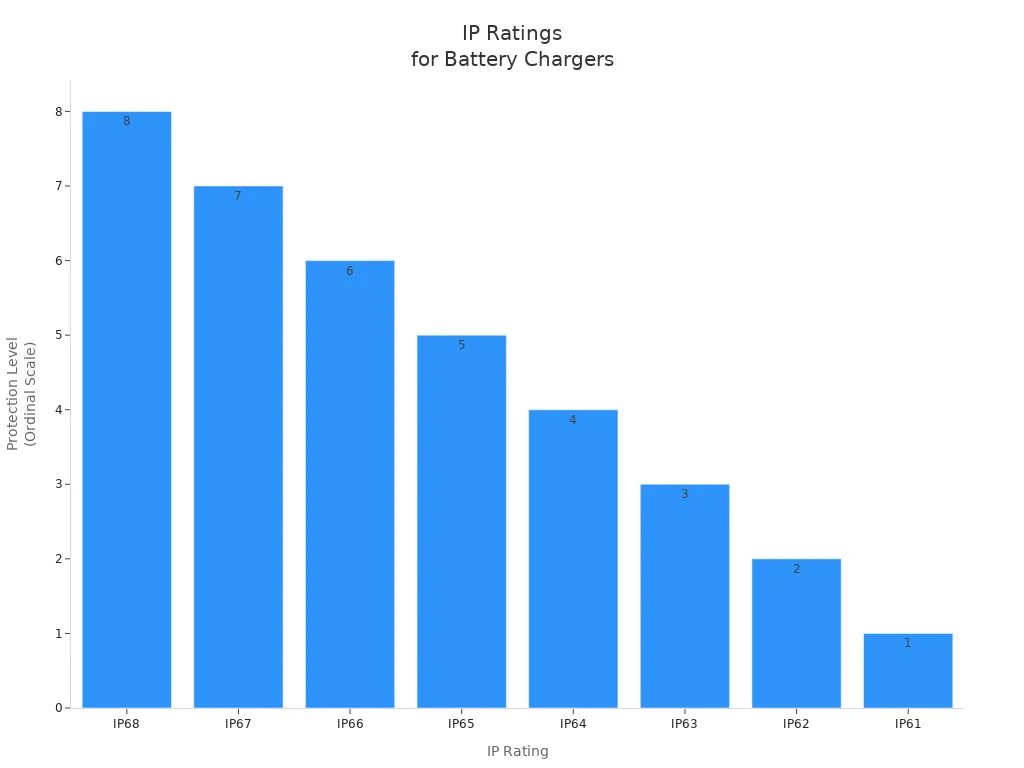
Some top brands give you high protection. For example, ProMariner’s ProTournament Elite has an IP67 rating. Noco’s Genius Gen has an IP68 rating. You can use these chargers in wet places and not worry.
You want your batteries and gear to stay safe. Onboard battery chargers have many safety features. These features stop problems before they happen. Here are some common safety protections:
Safety Feature | Description |
|---|---|
Reverse Polarity Protection | Stops damage if you connect the battery wrong. |
Short Circuit Protection | Turns off power if clamps touch, so nothing bad happens. |
Low-Voltage Cutoff | Stops charging broken batteries, so you stay safe. |
You also get overcurrent protection and temperature checks. These features keep your batteries from getting too hot or too much power. Many chargers use automatic battery checks and smart charging. The charger looks at the battery type and gives the best charge. This helps you avoid mistakes and keeps your batteries healthy. Strong chargers have waterproof and rust-proof cases. You can use them in boats and cars for a long time.
Note: Automatic battery checks and smart charging make charging easy and safe. You always get the right charge, no matter what battery you use.
You want a marine onboard battery charger that can handle hard jobs. Landworld Technology makes strong chargers for boats and tough places. These chargers use tough materials and smart designs. You get charging you can trust, even with saltwater, shaking, or bad weather.
Here is a table that shows how industrial-grade marine onboard chargers are different from regular models:
Feature | Industrial-Grade Marine Chargers | Consumer-Grade Models |
|---|---|---|
Durability | High | Moderate |
Environmental Resistance | IP65-rated enclosures | Lower IP ratings |
Charging Capabilities | Multi-stage charging | Basic charging |
Corrosion Resistance | Corrosion-resistant terminals | Standard materials |
Safety Features | Ignition protection | Limited safety features |
You get terminals that do not rust and cases that keep out water. These chargers have ignition protection, so you stay safe near fuel. Landworld Technology builds each marine onboard charger to last a long time on the water.
You need a charger that works well every time. Landworld Technology gives you chargers you can count on for electric vehicles and boats. The chargers use multi-stage charging to keep your batteries safe. You can trust them to work in dust, water, and heat.
If you need something special, Landworld Technology can make custom chargers. You can ask for different power, outputs, or smart features. The team will help you design a charger that fits your fleet or machines.
Tip: Custom chargers help your batteries work better and last longer for your special needs.
You get more than just a charger when you pick Landworld Technology. The company helps you from start to finish. You can ask for advice, help with setup, or service after you buy. Landworld Technology works with B2B partners in boats and electric vehicles.
You can count on quick answers and expert help. The team helps you fix problems and keep your business going. With Landworld Technology, you get a partner who wants you to do well.
Now you understand how an onboard battery charger works. It helps keep your batteries healthy and full. You get safe charging and automatic control. These chargers have strong features for boats and cars. When you pick a charger, remember these important things:
Make sure the voltage matches your system
Choose a charger type that fits what you need
Look for smart technology with multi-stage charging
Match the charger to your battery chemistry
Pick the right amperage for your battery size
These tips help you choose the best charger and keep your batteries safe.
First, read the instructions from the maker. Find a dry and safe place to put the charger. Attach the wires to the battery terminals. Plug the charger into a wall outlet. Make sure all wires are tight before you use it.
Yes, you can keep it plugged in. Smart chargers watch your battery and switch to maintenance mode. This keeps your battery full but does not overcharge or hurt it.
You can use lead-acid, AGM, gel, and lithium-ion batteries. Always look at your charger's manual to make sure it works with your battery.
Multiple banks let you charge more than one battery at once. Each bank works by itself. This helps you keep all your batteries ready to use.
Unplug the charger right away. Dry it all the way before you use it again. Many chargers are waterproof, but always check for damage before you plug it back in.


