
close
Choose Your Site
Global
Social Media


Views: 0 Author: Site Editor Publish Time: 2026-06-08 Origin: Site


The rapid evolution of electric vehicles (EVs) has driven the demand for highly efficient, compact, and versatile power systems. Among the critical components of any modern EV, on-board chargers (OBCs) and DC/DC converters are essential for managing energy flow between the battery, auxiliary systems, and external loads. These components ensure that energy is converted efficiently, delivered reliably, and integrated safely into the vehicle’s electrical architecture.
The combination of these systems in a 6.6kW OBC+3kW DC/DC 2-in-1 integration module provides a streamlined solution for both charging and energy management needs. This integration addresses common engineering challenges such as space constraints, thermal management, and system reliability while enabling new functionalities that traditional separate modules cannot provide.
Modern EV platforms increasingly require features such as Vehicle-to-Load (V2L) and bidirectional energy transfer, which allow vehicles not only to receive energy from the grid but also to supply power externally. These features expand the utility of EVs beyond simple mobility, creating opportunities for energy management, emergency supply, and flexible power applications. The 6.6kW OBC+3kW DC/DC system from Landworld Technology Co., Ltd. exemplifies these capabilities through a compact, efficient, and intelligent integrated design. This article explores the technical advantages, operational mechanisms, and performance benefits of this cutting-edge system, highlighting why it is indispensable for modern EV platforms.
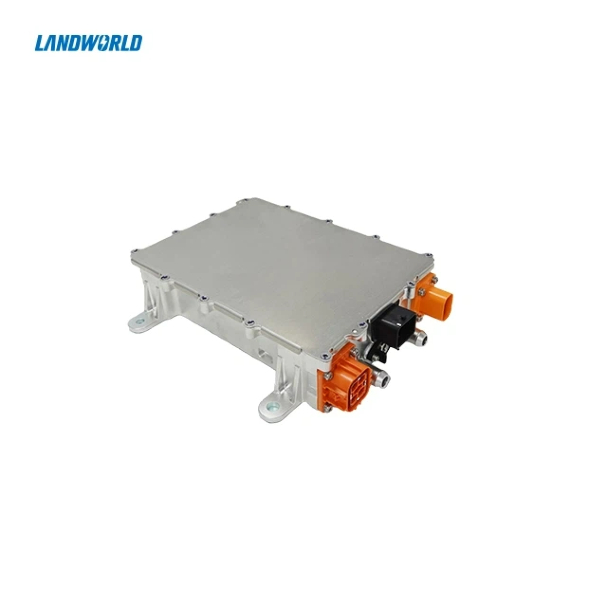
The 6.6kW OBC+3kW DC/DC system is a 2-in-1 integrated module that combines two essential power management functions in a single package. By unifying an on-board charger and a DC/DC converter into one module, it achieves higher energy efficiency, simplifies vehicle architecture, and reduces the installation footprint.
⦁ 6.6kW On-Board Charger (OBC): Converts alternating current (AC) from external sources into direct current (DC) for battery charging. It manages a wide range of input voltages, supports high efficiency, and maintains consistent output under fluctuating conditions.
⦁ 3kW DC/DC Converter: Steps down high-voltage DC from the main battery to a lower DC voltage suitable for auxiliary vehicle systems, including lighting, infotainment, HVAC, and safety electronics. The DC/DC module is optimized for minimal losses and rapid response to varying load demands.
⦁ Compact Size: 280 × 210 × 68 mm, allowing easy integration into EV platforms where space is constrained. The compact design also reduces wiring complexity and enhances vehicle modularity.
⦁ Lightweight: Less than 6 kg, reducing the overall mass of the vehicle. Lower weight contributes to improved energy efficiency and longer driving range.
⦁ High Efficiency: Both the OBC and DC/DC units maintain efficiency levels above 94%, reducing energy loss and heat generation.
⦁ Liquid Cooling: Ensures reliable performance even under extreme operating temperatures. Liquid cooling allows higher continuous power output compared to air-cooled systems and maintains thermal stability for sensitive electronic components.
The integration of OBC and DC/DC into a single module reduces installation complexity, minimizes wiring requirements, and provides centralized control and protection functions. This integration ensures consistent operation, enhanced safety, and streamlined maintenance, positioning the system as a future-ready solution for EVs.
Bidirectional functionality allows energy to flow in both directions: from the grid to the vehicle for charging, and from the vehicle to external loads or back to the grid. This dual functionality is a cornerstone of modern energy management in EVs, enabling the vehicle to serve as both a storage unit and an energy source.
⦁ Grid-to-Vehicle (G2V): Standard charging mode where AC power from the grid is converted by the OBC to DC for the battery. The module ensures that voltage and current are regulated to avoid battery stress.
⦁ Vehicle-to-Load (V2L) / Vehicle-to-Grid (V2G): Energy flows from the battery, converted by the DC/DC and OBC modules, to AC for external devices or the grid. The bidirectional design allows precise control of current direction, maintaining efficiency and safety.
The 6.6kW OBC+3kW DC/DC module leverages advanced digital controls to manage bidirectional current, voltage, and safety protections. These controls ensure that energy transfer is stable, efficient, and responsive to varying load conditions, without overloading any components.
Benefits of Bidirectional Operation:
Optimized energy utilization by allowing surplus energy to flow back to external loads.
Extended application beyond traditional charging, enabling more versatile energy management.
Enhanced integration with vehicle systems, reducing additional equipment and associated costs.
V2L functionality allows an EV to serve as a portable power source. With the 6.6kW OBC+3kW DC/DC system, users can convert DC battery energy into 220 VAC for powering external devices, providing energy independence without additional equipment.
The DC/DC converter steps down the high-voltage battery output to a stable auxiliary voltage, optimized for AC inversion.
The bidirectional OBC then converts DC into AC, producing a standard 220 VAC output compatible with external loads.
Integrated digital controls continuously monitor load demand, battery state-of-charge, and thermal conditions, ensuring safe and reliable power delivery.
Provides emergency power during grid outages, maintaining continuity for essential devices.
Supports flexible energy applications for outdoor, recreational, and industrial uses.
Enhances the functional versatility of EVs, increasing their utility without the need for separate inverters or generators.
Integrating the 6.6kW OBC+3kW DC/DC system into a single, compact module provides a range of significant advantages for EV designers and OEMs, directly addressing critical engineering and vehicle integration challenges.
By combining two discrete power modules into a single 2-in-1 unit, the system considerably reduces the physical footprint within the vehicle chassis. This compact integration allows designers to better utilize limited installation space, leaving more room for other essential components or battery systems. Additionally, the reduced weight contributes to overall vehicle efficiency, enhancing driving range and minimizing energy consumption during operation. This streamlined design also simplifies the assembly process, reducing installation time and labor costs for manufacturers.
A unified liquid-cooling system efficiently manages heat generated by both the OBC and DC/DC units simultaneously. By maintaining a consistent operating temperature, it prevents hotspots that could degrade electronic components or reduce efficiency over time. The simplified thermal architecture eliminates the need for separate cooling loops for individual modules, which reduces both cost and complexity in vehicle design while improving long-term reliability.
The integrated system supports configurable input and output voltage ranges, current levels, and communication protocols. This flexibility ensures compatibility with multiple EV architectures, enabling faster integration, easier adaptation to new vehicle models, and enhanced scalability for future platforms.
The 6.6kW OBC+3kW DC/DC system delivers high efficiency and stable performance, essential for maximizing vehicle energy utilization and reducing operational costs.
Feature | Specification | Benefit |
OBC Power | 6.6 kW | Efficient battery charging with minimal energy loss |
DC/DC Power | 3 kW | Stable supply for auxiliary systems |
Efficiency | ≥94% | Minimizes energy loss, improves battery utilization |
Cooling | Liquid-cooled | Maintains performance under extreme temperatures |
Safety Protections | Overvoltage, short circuit, communication fault | Ensures operational reliability |
Communication | CAN-FD | Facilitates seamless integration with vehicle control units |
Consistent output under wide temperature ranges and varying load conditions.
High efficiency reduces energy loss, contributing to longer driving range.
Multi-level safety protections safeguard the vehicle’s electrical system and the battery.
The system employs advanced digital controls to manage energy flow precisely.
⦁ Precision Energy Management: Monitors voltage, current, and temperature for real-time regulation.
⦁ Remote Diagnostics: Supports software updates and fault detection via CAN-FD interface.
⦁ Layered Protection Mechanisms: Multi-level electrical and thermal safety ensures both OBC and DC/DC operate reliably under all conditions.
Digital intelligence allows the module to respond dynamically to load changes, battery conditions, and environmental factors, maximizing performance and longevity.
The 6.6kW OBC+3kW DC/DC 2-in-1 system represents a major leap in electric vehicle power integration. By enabling bidirectional power flow, it allows energy to transfer seamlessly in both directions under precise intelligent control. Its Vehicle-to-Load functionality provides portable power for external devices without additional equipment, while the compact, high-efficiency design maximizes installation space, reduces weight, and minimizes energy loss. Built with layered safety protections and advanced digital control, the system ensures reliable, stable operation under a wide range of conditions. For manufacturers and engineers looking to optimize EV platforms with cutting-edge, integrated power solutions, we invite you to learn more about how we can support your projects. By exploring our modules, you can enhance vehicle efficiency, expand functionality, and achieve safer, smarter energy management. Contact us at Landworld Technology Co., Ltd. to discover how our innovative solutions can help take your electric vehicle designs to the next level.
Q1: What is the maximum output power for V2L using the 6.6kW OBC+3kW DC/DC system?
A1: The system can provide up to 220 VAC output for external devices, leveraging the 3kW DC/DC converter in bidirectional mode.
Q2: Is the 6.6kW OBC+3kW DC/DC module compatible with extreme temperatures?
A2: Yes, it operates reliably in temperatures ranging from -40°C to 85°C with liquid cooling support.
Q3: Which communication protocols are supported?
A3: CAN-FD is used for seamless integration with modern EV control units, enabling bidirectional and V2L operations.
Q4: Can the system be adapted to different EV platforms?
A4: Yes, the module is modular and supports custom input/output voltages and currents for multiple vehicle architectures.
Q5: How does the integrated design benefit OEMs?
A5: By combining OBC and DC/DC into a single module, installation space is reduced, wiring is simplified, and overall energy efficiency is enhanced.


