
close
Choose Your Site
Global
Social Media


Views: 0 Author: Site Editor Publish Time: 2026-09-01 Origin: Site


OBC power rating is one of the main factors that determines how quickly an electric vehicle can charge from an AC source. The on-board charger (OBC) converts AC power supplied by the EVSE into controlled DC power for the high-voltage battery. However, the OBC rating alone does not determine actual charging speed. Available AC power, battery voltage, battery-management limits, temperature, state of charge, auxiliary loads, and conversion efficiency can all reduce the effective charging power.
For EV manufacturers and vehicle integrators, the practical question is therefore not simply whether a higher-power OBC charges faster. The better question is whether the vehicle, battery, charging infrastructure, and thermal system can make effective use of that additional OBC power.
A useful first-stage estimate is:
Approximate charging time = Energy required by the battery ÷ Effective charging power
For example, if an 80 kWh battery needs to recover 40 kWh of energy, ideal charging time would be approximately 6.1 hours at 6.6 kW, 3.6 hours at 11 kW, and 1.8 hours at 22 kW. Real charging time will normally be longer because the system does not operate at ideal rated power under every condition.
The on-board charger converts external AC power into DC power suitable for charging the vehicle battery.
OBC rated power sets an upper limit on the vehicle's AC power-conversion capability, but actual charging power may be lower.
Charging time depends on the amount of battery energy to be recovered and the lowest effective power limit in the charging chain.
Higher OBC power is useful only when the AC supply, EVSE, cable, battery, cooling system, and vehicle controls can support it.
Efficiency affects energy loss and thermal load, but OBC performance should be evaluated across the actual operating range instead of relying on one headline efficiency value.
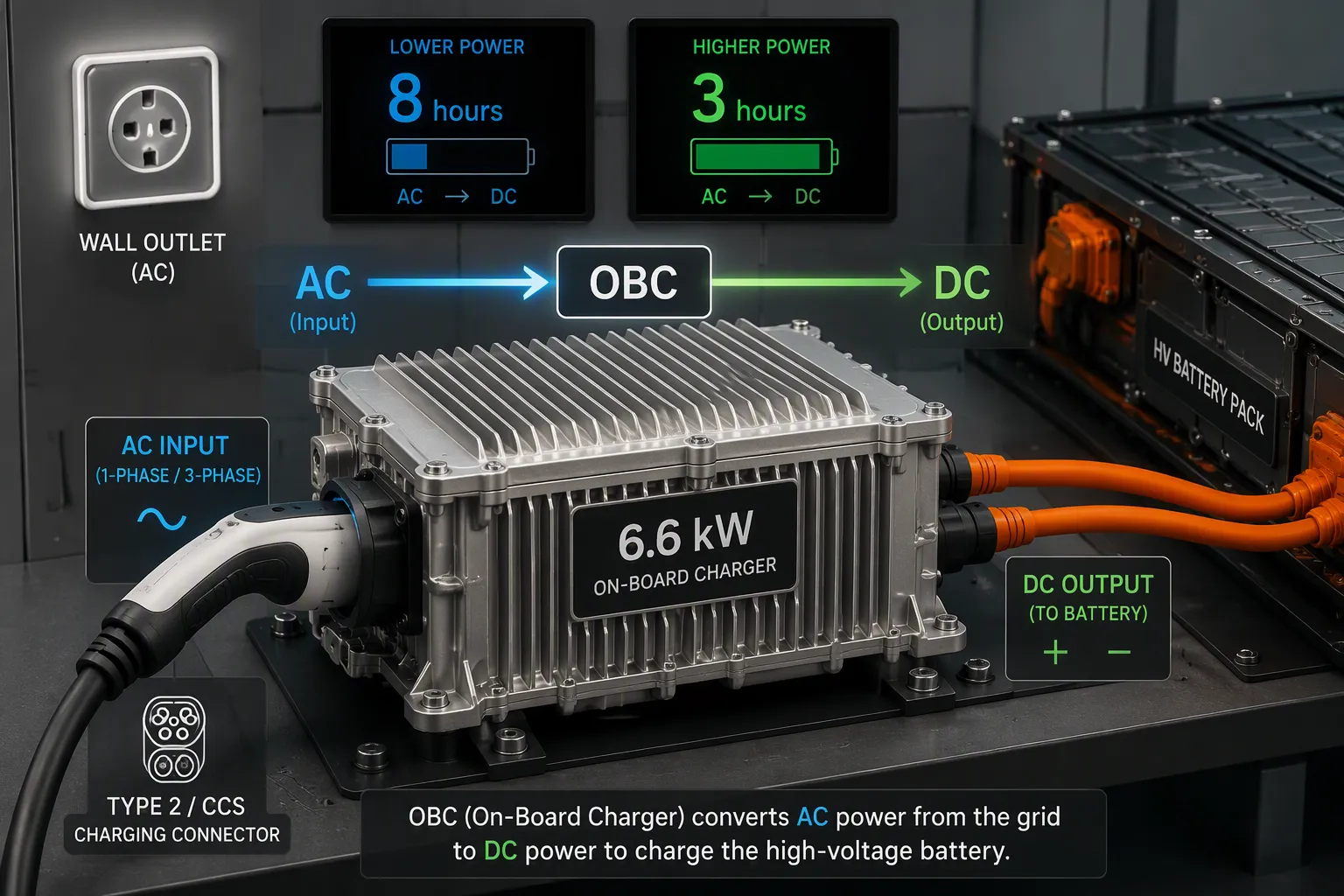
Most electric vehicles that support conductive AC charging use an on-board charger as the vehicle-side AC/DC power-conversion stage. The OBC receives AC input from compatible charging equipment and converts it into regulated DC output that can be controlled according to the high-voltage battery's charging requirements.
The OBC normally works together with the battery management system (BMS), vehicle control unit (VCU), charging interface, and thermal-management system. The battery does not simply accept whatever power the OBC can produce. Charging voltage and current are coordinated according to battery state of charge, temperature, protection limits, and the vehicle's charging strategy.
In conventional AC charging, power passes through the OBC before reaching the high-voltage battery. In off-board DC fast charging, the external DC charger performs the main AC/DC conversion, so high-power DC charging does not pass through the OBC's normal AC power-conversion path.
Charging Method | Main Power Conversion | OBC Role |
|---|---|---|
AC charging | Inside the vehicle | Converts AC input to controlled DC output for battery charging |
Off-board DC charging | Inside the external DC charger | Normal OBC AC/DC power stage is bypassed for traction-battery charging |
Some OBC architectures also support bidirectional power conversion. Depending on the wider vehicle and charging architecture, this may support applications such as V2L or other bidirectional energy functions. However, bidirectional OBC hardware alone does not automatically provide a complete V2G or V2H system; vehicle control, EVSE compatibility, communication, protection, and applicable grid requirements must also be considered.
The OBC power rating represents the charger's designed AC-to-DC conversion capability under specified operating conditions. If a vehicle has an 11 kW OBC, connecting it to an AC charging point capable of 22 kW does not automatically make the vehicle charge at 22 kW. The vehicle remains limited by its OBC capability and other vehicle-side conditions.
Conversely, installing a higher-power OBC does not guarantee faster charging when the available AC source cannot supply the required power. A 22 kW OBC connected to an AC source that can provide only 7 kW will be limited to approximately that available input level before other losses and vehicle restrictions are considered.
Actual AC charging power is determined by the most restrictive effective limit in the charging chain—not by the OBC nameplate rating alone.
Battery capacity alone does not tell you how long a charging session will take. First calculate how much energy needs to be restored between the starting and target state of charge.
A simplified calculation is:
Energy required (kWh) = Battery usable capacity × SOC increase
For example, an 80 kWh usable battery charging from 30% to 80% needs approximately 40 kWh of additional stored energy.
For a first estimate:
Charging time (h) ≈ Energy required (kWh) ÷ Effective battery charging power (kW)
If conversion efficiency needs to be considered from AC input power, one simplified approximation is:
Battery-side power ≈ AC input power × OBC efficiency
However, this remains only an estimate. Actual OBC efficiency changes with input voltage, battery voltage, output load, temperature, semiconductor topology, and control conditions. In addition, the BMS may command less power than the OBC could theoretically deliver.
Energy to Recover | 6.6 kW OBC* | 11 kW OBC* | 22 kW OBC* |
|---|---|---|---|
20 kWh | ≈3.0 h | ≈1.8 h | ≈0.9 h |
40 kWh | ≈6.1 h | ≈3.6 h | ≈1.8 h |
60 kWh | ≈9.1 h | ≈5.5 h | ≈2.7 h |
*Illustrative ideal calculation based on energy ÷ rated power. Actual charging time will be longer or different depending on efficiency, available AC power, battery limits, temperature, SOC, and vehicle control strategy.
From a vehicle-development perspective, charging power should be treated as a complete system chain rather than an isolated OBC specification.
Possible Limiting Factor | How It Affects Charging |
|---|---|
Available AC supply | Cannot provide more power than the local electrical infrastructure supports |
EVSE output | Sets the available AC current/power delivered to the vehicle |
Cable and connector | Must support the required current, phase configuration, and charging interface |
OBC rating | Limits vehicle-side AC/DC conversion capability |
Battery/BMS | May request less charging current due to SOC, voltage, temperature, or battery-protection strategy |
Thermal system | May require charging-power derating when OBC, battery, coolant, or ambient temperatures exceed defined limits |
Auxiliary loads | HVAC, pumps, battery heating/cooling, and other loads can reduce net power stored in the battery |
Consider an EV platform equipped with an 11 kW OBC. If the available EVSE supplies approximately 7 kW, the vehicle cannot use the OBC's full 11 kW capability. In that operating condition, the upstream AC supply becomes the primary power limit.
Shared charging infrastructure can create a similar effect. Fleet depots or commercial facilities may dynamically distribute available power between multiple connected vehicles. Even if every vehicle has an 11 kW or 22 kW OBC, each vehicle may receive less power when site-level load management is active.
This is why EV manufacturers should evaluate target-market charging infrastructure when specifying OBC power. A higher rating creates value only when the intended operating environment can regularly provide enough AC power to use it.
If an AC charging point can provide 22 kW but the vehicle uses a 6.6 kW OBC, the vehicle cannot convert AC power at 22 kW. In this case, the OBC is the primary limit.
The same principle applies to other OBC power ratings: when the available AC power exceeds the OBC's rated charging power, the OBC becomes the limiting factor in the charging chain.
The BMS controls permissible battery charging voltage and current according to battery state, chemistry, temperature, cell balance, and protection requirements. Therefore, even if both the EVSE and OBC can support a higher power level, the BMS may request lower charging current.
This effect can become more visible at high state of charge or under unfavorable thermal conditions. Charging behavior should therefore be based on the actual battery-control strategy rather than assuming constant rated OBC power from the beginning to the end of every charging session.
OBC power should not be assigned to vehicle classes through rigid rules such as "6.6 kW for family cars" or "22 kW for luxury vehicles." Vehicle architecture and duty cycle matter more than price segment.
Landworld's current OBC portfolio, for example, includes multiple power levels for passenger, commercial, off-road, forklift, marine, and specialized EV programs. Different projects can therefore use similar OBC ratings for very different reasons.
OBC Power Class | Possible Selection Logic | Vehicle-Level Considerations |
|---|---|---|
3.3 kW | Lower AC charging requirement or long available charging window | Battery size, duty cycle, packaging, cooling, cost |
6.6 kW | Balanced AC charging power for many single-phase-oriented or specialized vehicle programs | Target market, charging window, battery energy, available AC supply |
11 kW | Faster AC charging where compatible infrastructure is available | Often associated with three-phase AC architectures in relevant markets |
20–22 kW | Higher AC energy recovery or shorter turnaround requirements | Greater thermal, packaging, cost, and infrastructure requirements |
Higher-power OBC | Selected commercial or specialized vehicle programs | Vehicle architecture, grid connection, thermal system, continuous-power requirement |
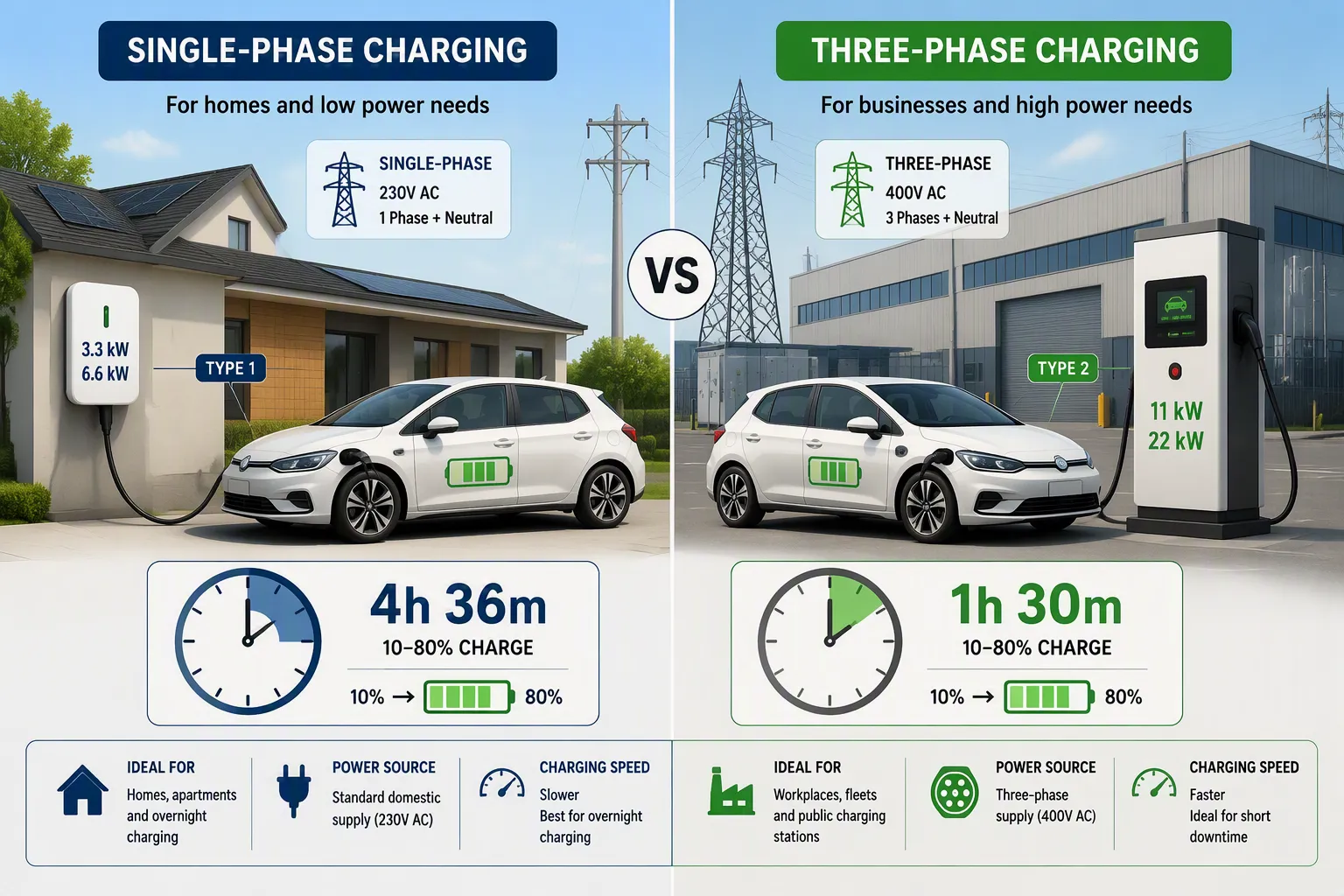
Phase configuration affects the amount of AC power that can practically be supplied under a given grid architecture, but three-phase charging should not be described as inherently "more efficient" in every situation.
For example, approximately 11 kW AC charging is commonly achieved using three-phase 400 V-class infrastructure at around 16 A per phase. Approximately 22 kW is commonly associated with around 32 A per phase under similar three-phase infrastructure. Actual requirements depend on the OBC and market specification.
Single-phase OBC solutions remain appropriate for many vehicle applications, especially where target-market infrastructure, duty cycle, cost, or packaging does not justify a three-phase architecture.
For more detail on 11 kW AC charging performance, see Landworld's guide to 11 kW OBC charging speed.
OBC efficiency determines how much of the AC input power is converted into useful battery-side DC power and how much is lost, primarily as heat.
However, it is misleading to assign fixed efficiency bands solely according to OBC power rating—for example, assuming that all 6.6 kW products have one efficiency range while every 22 kW product is automatically more efficient.
Actual efficiency depends on:
AC input voltage and phase
Battery output voltage
Output power/load point
Power-conversion topology
Semiconductor technology
Switching strategy
Temperature and cooling conditions
Higher efficiency reduces conversion loss and therefore reduces the difference between AC input power and battery-side charging power. It also lowers thermal load, which can help the OBC maintain rated output under demanding operating conditions.
For engineering evaluation, review the efficiency map across representative operating points rather than comparing only peak efficiency. See Landworld's explanation of how efficient an on-board charger can be for more background.
Battery temperature affects the amount of charging current the BMS permits. Under cold conditions, the vehicle may reduce battery charging current or consume part of the incoming energy for battery heating. At elevated temperature, charging current may also be reduced to protect battery cells.
For this reason, it is better to avoid applying one universal "best battery charging temperature" or one fixed thermal limit to every EV platform. Battery chemistry, pack design, cell supplier requirements, cooling system, and control strategy determine the acceptable temperature window.
The OBC itself also generates heat during power conversion. If coolant temperature, component temperature, or ambient conditions exceed the charger's full-power operating envelope, the system may reduce output to protect the power electronics.
Vehicle manufacturers should therefore evaluate:
Continuous rated power
Ambient operating range
Coolant inlet-temperature limits
Required coolant flow where applicable
Thermal derating curve
Protection and restart behavior
These parameters matter especially for commercial and off-road EVs that may charge after operating under high-load or high-temperature conditions.
A higher OBC rating should be selected because it creates value for the target vehicle program—not simply because a larger kW number appears more advanced.
Selection Question | Why It Matters |
|---|---|
How much battery energy must normally be recovered? | Defines the practical charging workload |
How long is the available AC charging window? | Determines the minimum useful charging power |
What AC infrastructure exists in target markets? | Determines whether higher OBC power can be used |
What battery voltage range must the OBC support? | Defines DC output and power-stage requirements |
What cooling system is available? | Affects continuous power and packaging |
What size, mass, and cost limits apply? | Higher power can increase system-level integration requirements |
Does the project require bidirectional or integrated functions? | May change topology and overall power-system architecture |
Landworld develops on-board charging solutions for passenger vehicles, commercial vehicles, off-road EVs, forklifts, marine electric vehicles, and other specialized electric platforms. Its current on-board charger range includes multiple power classes from lower-power OBCs through 11 kW, 13 kW, 20 kW, 22 kW, and higher-power solutions.
Different products also use different cooling approaches. For example, selected lower-power Landworld OBCs use fan cooling, while higher-power and high-power-density configurations are available with liquid cooling. This allows the OBC to be matched more closely to the vehicle's thermal architecture rather than applying one cooling method to every power level.
Landworld also offers bidirectional and integrated OBC/DC-DC configurations for projects that require more than stand-alone AC charging.
When selecting an OBC, Landworld recommends evaluating the battery voltage range, charging-power requirement, AC input configuration, cooling conditions, communication interface, package space, target vehicle application, and expected operating environment together.
For passenger vehicle projects, you can review Landworld's electric passenger car solutions. Other vehicle platforms may require different combinations of OBC power, voltage, cooling, and mechanical packaging.
Landworld supports customization in areas such as power, voltage, and form factor for different EV programs. Learn more about Landworld or contact the team with your vehicle specifications.
OBC power rating has a direct influence on potential AC charging time, but the relationship is not simply "more kW equals faster charging." The real charging rate is limited by the complete system: AC supply, EVSE, cable and connector, OBC, battery/BMS, thermal conditions, and vehicle control strategy.
For EV manufacturers, a 6.6 kW, 11 kW, 22 kW, or higher-power OBC should therefore be selected according to the required energy recovery, available charging window, target-market infrastructure, battery architecture, cooling system, packaging, and cost.
If you are defining AC charging requirements for a new EV platform, explore Landworld's on-board charger portfolio, review the company's EV power electronics capabilities, or contact Landworld with your target OBC power, battery voltage, AC input, cooling, communication, and vehicle application requirements.
First determine how much battery energy needs to be recovered. Divide that energy by the effective battery-side charging power. For example, recovering 40 kWh at an ideal 11 kW would take about 3.6 hours. Actual charging time will normally be longer because of conversion losses, battery limits, thermal conditions, and variations in available AC power.
No. A higher OBC rating only reduces charging time when the rest of the charging system can support that power. An EV equipped with a 22 kW OBC may still charge at approximately 7 kW if the connected AC source can provide only 7 kW. Likewise, the BMS or thermal system may request less than the OBC's rated power.
Yes, if the charging interface, voltage, communication, and phase configuration are compatible. However, the vehicle will normally remain limited to approximately the capability of its 11 kW OBC rather than charging at the station's full 22 kW rating.
No. Three-phase infrastructure can support higher AC power under many grid architectures, but conversion efficiency depends on the specific OBC design and operating point. Phase count alone does not prove that one OBC will be more efficient than another.
Higher efficiency means a larger proportion of the available AC input power reaches the battery as useful DC power and less is lost as heat. The effect on total charging time depends on the efficiency difference and operating conditions. Compare efficiency across realistic input voltage, battery voltage, load, and temperature points rather than relying only on peak efficiency.
Usually not as a simple component swap. The OBC is integrated with the vehicle's battery voltage, cooling system, electrical architecture, communication, mechanical packaging, software, safety strategy, and homologation. Increasing OBC power normally requires vehicle-level engineering and validation rather than replacing one charger with another.
Compare the battery energy that normally needs to be recovered, required charging window, AC infrastructure in target markets, battery voltage, phase configuration, thermal architecture, packaging, cost, and vehicle duty cycle. The appropriate OBC power rating is the one that meets the vehicle program's charging objectives while fitting the available AC infrastructure, battery limits, thermal architecture, packaging, and system margin.


