
close
Choose Your Site
Global
Social Media


Views: 0 Author: Site Editor Publish Time: 2026-07-15 Origin: Site


You can find the ev on-board charger in every electric vehicle. It gets electricity from the power grid. It changes alternating current (AC) into direct current (DC) for the battery. This on-board charger helps make charging safe and fast. It does this by lowering energy loss. You can charge your car faster when the charger works well. It also keeps your battery safe. It does this by switching between constant current and constant voltage modes.
The charger works best when using higher currents.
Most energy loss happens when changing AC to DC.
Power factor correction helps use energy better.
An EV on-board charger changes AC power from the grid into DC power for the battery. It makes sure charging is safe and efficient.
The charger checks voltage and current to keep the battery safe. It stops the battery from getting too full or too hot. This helps the battery last longer.
On-board chargers with higher power ratings charge faster. This gives you more driving range each hour.
Some chargers have advanced features like bidirectional charging. This lets EVs send power back to homes or the grid. It helps save energy.
Knowing how your EV charges helps you make smart choices about safety and energy use.

You will see an ev on-board charger inside every electric car. It connects the power grid to your car’s battery. The ev onboard charger takes AC power from places like your home outlet. It changes this AC power into DC power for the battery pack. The on-board charger acts like a helper. It makes sure your battery gets the right energy.
A normal ev onboard charger has some key parts:
AC/DC Converter – Changes AC power into DC power.
Power Factor Controller – Makes charging better for the grid.
DC-DC (LLC) Converter – Gives steady voltage to the battery.
Communication Interfaces – Talks to the battery system and charging station for safety.
Safety & Isolation Circuits – Stops overcharging, overheating, and electrical trouble.
The obc has a front AC-DC stage and a back DC-DC stage. These parts work together. They give your battery safe and steady power.
You need an ev on-board charger because your car’s battery stores DC power. The power grid and most charging stations give AC power. The grid uses AC power because it travels far and handles high voltages. Your battery cannot use AC power. The ev onboard charger fixes this by changing AC power into DC power for your battery.
The obc also controls charging. It talks to the charging station and battery management system. This helps set the right voltage and charging limits. Without an on-board charger, you could not charge your EV at home or at public stations. The obc makes charging easy and safe.
Tip: The obc does more than change power. It keeps your battery safe by charging at the right speed and voltage.
The main job of the ev on-board charger is to change AC power from the grid into DC power for your battery. Here is how it works:
The obc gets AC power from a charging station or wall outlet.
An EMI filter takes away unwanted electrical noise.
The power factor correction (PFC) stage turns AC voltage into steady DC voltage, called “bus voltage.”
An isolated DC-DC converter changes this voltage to fit your battery.
The obc sends the right DC power to the battery for safe charging.
This lets you charge your EV at home or at public AC stations. The obc makes sure your battery gets the right power every time.
You may wonder how well this conversion works. The table below shows how efficient different charging levels are:
Charging Level | Efficiency Rate |
|---|---|
Level 1 | ~80% |
Level 2 | >90% |
DC Fast | >90% |
A high-efficiency ev onboard charger wastes less energy. It also charges your EV faster.
When you plug your EV into a power source, charging starts. The onboard charger checks if the connection is safe. It also checks the voltage. Then, it sends a signal to get ready for charging. The charger decides how much current your battery can take. Charging begins while the vehicle controller watches everything. Charging will stop if your battery is full or if there is a problem.
The onboard charger works with the battery management system. This system checks each battery cell’s voltage and temperature. It also checks the charging current. The system looks at isolation resistance to keep you safe. The battery management system talks to smart chargers and loads. These smart devices use microprocessors to share important charging information.
Note: The obc and battery management system work together to keep your EV safe during charging.
You need the right voltage and current for safe charging. The obc uses different ways to control these levels. One way is the trickle-constant current-constant voltage method. It starts with a slow trickle charge for empty batteries. Then, it uses a steady current until the battery reaches a set voltage. After that, the charger keeps the voltage steady while the current goes down.
Some onboard chargers use a five-stage charging method. This method changes the current at each stage for your battery. Pulse charging sends short bursts of current. This helps ions move and keeps the battery healthy. Boost charging uses special circuits to keep voltage steady and use power better.
The obc always changes voltage and current to fit your battery. This helps your EV charge faster and keeps the battery safe.
You want your EV battery to last a long time. The obc helps by watching for problems like overcharging and overheating. It uses sensors to check voltage and temperature. If the battery gets too hot or the voltage is too high, the charger will stop or turn on cooling.
The obc uses flame-retardant materials and fast disconnect switches to stop fires. Smart monitoring systems look for early signs of trouble and warn you. By managing charging, the obc stops overcharging and thermal runaway. It also helps your battery stay healthy by avoiding high heat and other risks.
Tip: Good charging habits and a reliable obc help your EV battery last longer and keep you safe.
You will find that the power rating of an obc affects how fast your ev charges. Most onboard chargers for electric vehicles range from 2 kW to 22 kW. Higher power means faster charging. If your ev has a 7 kW obc, it will charge slower than one with a 22 kW obc. The table below shows how different chargers compare:
Charger Type | Voltage (V) | Amperage (A) | Power (kW) |
|---|---|---|---|
Level 2 | 240 | 30 | 7.2 |
Level 2 | 240 | 32 | 7.7 |
Level 2 | 240 | 48 | 11.5 |
Level 2 | 240 | 80 | 19.2 |
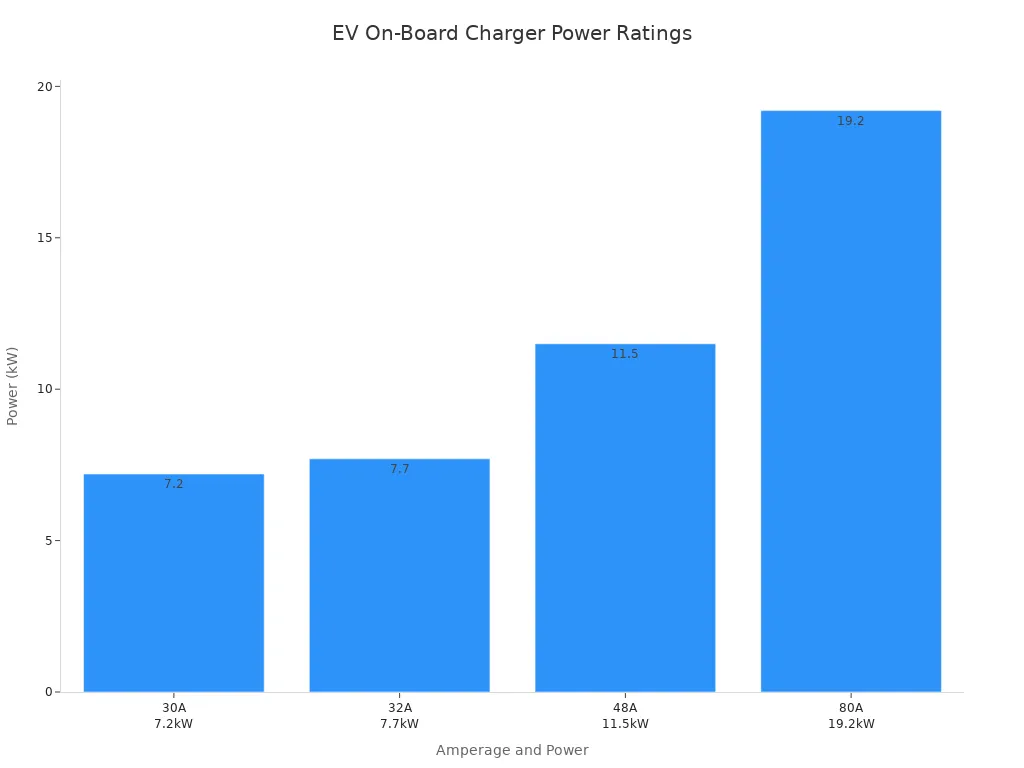
A 7 kW charger usually takes 8 to 10 hours to fully charge a standard battery. A 22 kW charger can do the same job in about 5 to 6 hours. You get more driving range per hour with higher power. For example, a 7 kW charger adds up to 45 km per hour, while a 22 kW charger can add up to 130 km per hour.
Your ev can use different types of charging stations. The obc decides how much power your car can take. Most evs work with Level 1 and Level 2 stations. Some may not work with DC fast chargers. The table below shows the main types:
Charging Station Type | Voltage | Current | Power Output |
|---|---|---|---|
Level 1 | 120 V | 15 A | 2 kW |
Level 2 | 240 V | 60 A | Up to 22 kW |
DC Fast Charger | 208-600 V | Varies | 50 kW to 350 kW |
All evs can use Level 1 and Level 2 charging.
Some obc units only support single-phase charging. Others support both single-phase and three-phase.
If your ev has a three-phase obc, you can use both single-phase and three-phase stations.
The slowest part of the system sets the charging speed.
Tip: The obc in your ev controls the maximum charging speed, even if the station can provide more power.
Modern obc units offer more than just basic charging. You can find advanced features like:
Bidirectional charging (lets your ev send power back to your home or the grid)
Vehicle-to-Home (V2H) and Vehicle-to-Grid (V2G) support
Smart charging management for better energy use
Bidirectional charging lets energy flow both ways. Your ev can help power your house during an outage. It can also send energy back to the grid. This helps balance electricity supply and demand. With millions of evs, this feature can support the whole power grid. Smart obc systems also improve safety and make charging easier for you.
Note: Advanced obc features can help you save money and support clean energy.
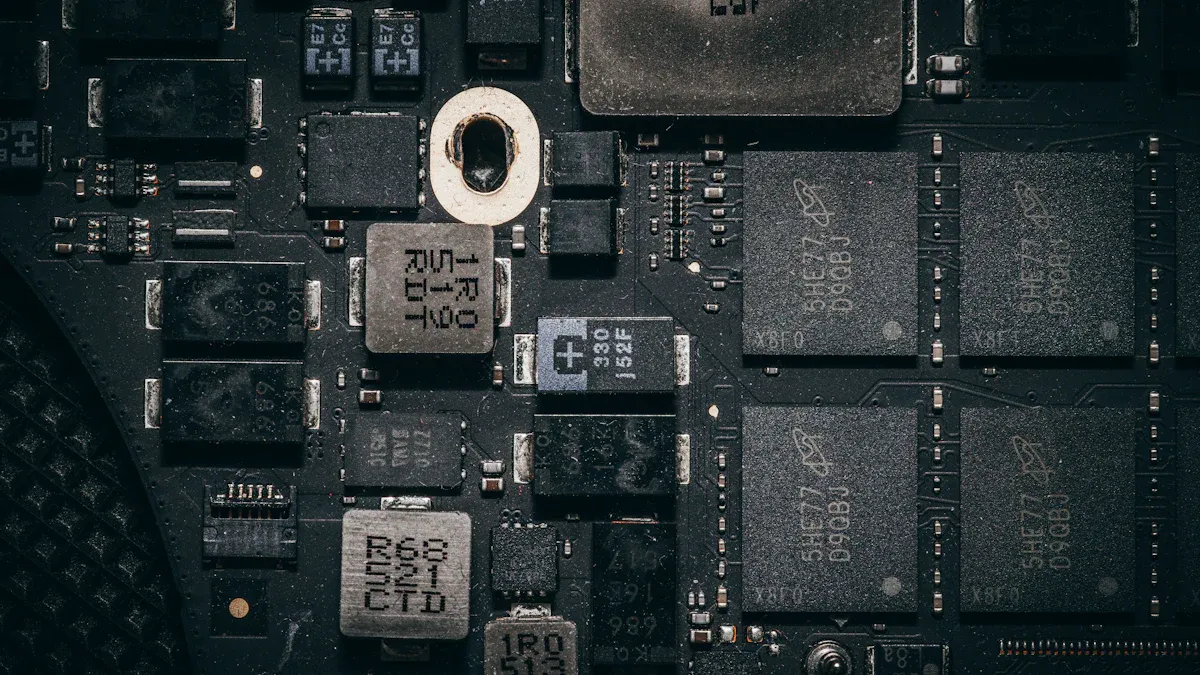
You want your ev to charge safely and quickly. Landworld Technology makes top onboard chargers. Their newest 6.6 kW bidirectional charger is very small. It is 40% smaller than older chargers. This helps you save space in your ev. The charger has the highest power density right now. You get lots of power in a tiny charger.
Landworld Technology uses a strong safety system. The onboard charger follows many world standards. You can use it in evs everywhere. The software uses AUTOSAR architecture. This makes it easy to reuse and lowers costs. Landworld Technology gives you reliable and smart charging solutions.
If you build evs for business, you need good chargers. Landworld Technology has many products for different jobs. The table below shows some main choices:
Product Type | Power Range | Application Focus |
|---|---|---|
DC/DC Converter | 6–12 kW | Heavy-duty EV applications |
On-board Charger (OBC) | 40–80 kW | Modular power solutions for electric commercial vehicles |
You can use these chargers for:
Depot charging
Backup AC charging
Regional operation
Platform flexibility
Landworld Technology gives you high-quality onboard charger systems. Their chargers are fast and safe for every ev. Their solutions help you meet modern ev needs and keep your business strong.
You are important for the future of ev technology. The on-board charger links your ev to the grid. It changes AC power into DC power. This keeps charging safe for your battery. If you know how your ev charges, you can make smart choices. These choices help with safety and using energy well. You should look for fast charging and smart systems. Pick a brand that you can trust. More people are buying evs now. Smart chargers and bidirectional charging will change how you use energy each day.
If your on-board charger fails, your EV will not charge from AC sources. You may need to visit a service center. Some EVs can still use DC fast charging if the charger only handles AC.
You cannot usually upgrade the on-board charger. The charger is built into your EV. If you want faster charging, you need to choose a model with a higher-rated charger when you buy your EV.
Yes, the on-board charger helps protect your battery. It controls voltage and current during charging. This keeps your battery healthy and helps it last longer.
Yes, you can safely charge your EV overnight. The on-board charger and battery management system monitor charging. They stop charging when the battery is full to prevent overcharging.


