
close
Choose Your Site
Global
Social Media


Views: 0 Author: Site Editor Publish Time: 2026-09-05 Origin: Site


A bidirectional on-board charger (OBC) is worth considering when an electric vehicle platform needs more than conventional AC charging. Unlike a unidirectional OBC, which primarily converts AC power into DC power for the high-voltage battery, a bidirectional OBC can also support controlled power flow from the vehicle battery back toward an external AC load or energy system.
For EV manufacturers and vehicle integrators, this capability can support vehicle-to-load (V2L), vehicle-to-home or building (V2H/V2B), and vehicle-to-grid (V2G) architectures. However, a bidirectional OBC alone does not create a complete V2G or V2H system. Vehicle controls, BMS strategy, charging equipment, communication protocols, protection devices, grid-interconnection requirements, and regional regulations must also support the intended function.
The decision to use a bidirectional OBC should therefore be made at vehicle-architecture level. This guide explains when bidirectional charging adds real value, what additional system requirements need to be considered, and when a conventional unidirectional OBC may still be the more appropriate choice.
A bidirectional on-board charger supports power conversion in both charging and discharge directions.
Use a bidirectional OBC when the vehicle platform is intended to support V2L, V2H/V2B, V2G, fleet energy management, or other power-export functions.
V2H and V2G are system-level capabilities. The OBC must work with compatible vehicle controls, EVSE, communication, protection, and grid infrastructure.
ISO 15118-20 may be relevant where EV–EVSE communication for bidirectional power transfer is required, while grid-interactive AC V2G projects may also involve regional interconnection requirements.
Battery degradation should be evaluated according to battery chemistry, SOC window, depth of discharge, temperature, cycle strategy, and expected bidirectional duty cycle instead of relying on one universal percentage.
A conventional on-board charger is primarily designed for one-way energy transfer during AC charging. It converts incoming AC power into regulated DC output that can be delivered to the traction battery under the control of the BMS and vehicle charging system.
A bidirectional on-board charger adds reverse power-conversion capability. Depending on the architecture, the OBC can convert battery-side DC energy back into controlled AC output for an external load or grid-connected system.
Function | Unidirectional OBC | Bidirectional OBC |
|---|---|---|
Grid/EVSE to battery | Supported | Supported |
Battery to external AC load | Normally not supported | Can be supported depending on system architecture |
Battery to grid | Not supported through conventional one-way OBC architecture | Possible when vehicle, EVSE, communication, interconnection, and regulatory requirements are satisfied |
Typical use | AC battery charging | AC charging plus V2L/V2H/V2G-related power-export functions |
During normal AC charging, electrical energy flows from the grid or EVSE through the OBC and into the high-voltage battery. The charger regulates voltage and current according to vehicle and BMS commands.
During reverse operation, DC energy from the traction battery is converted back into AC. The required AC characteristics depend on the intended application. Supplying an isolated external load is fundamentally different from operating in parallel with a utility grid.
This distinction is important because a vehicle capable of powering an appliance through V2L does not automatically satisfy the requirements for V2G. Grid-parallel operation introduces additional requirements for synchronization, protection, anti-islanding or related interconnection behavior, communication, authorization, and regulatory compliance.
Bidirectional capability is most valuable when energy export creates a defined customer, operational, or grid-service benefit. The OBC should not be made bidirectional simply because the technology is available.
Vehicle Requirement | Bidirectional OBC Value |
|---|---|
V2L power output | Can provide vehicle-side DC-to-AC conversion capability for external loads where architecture supports it |
V2H / V2B | Allows stored vehicle energy to participate in compatible home or building energy systems |
V2G | Provides vehicle-side bidirectional conversion for compatible grid-interactive architectures |
Fleet energy management | Can enable controlled charge/discharge scheduling across parked fleet vehicles |
Commercial/off-road auxiliary power | May reduce dependence on separate generators or auxiliary power equipment in suitable applications |
Conventional overnight charging only | Bidirectional functionality may provide limited value if no power-export use case exists |
Vehicle-to-load is one of the most direct bidirectional use cases because energy from the traction battery is used to power external electrical loads rather than being exported into the utility grid.
V2L can be valuable for:
Commercial service vehicles that need power tools or equipment
Construction and off-road equipment
Emergency or temporary power applications
Outdoor and mobile-work applications
Special-purpose vehicles requiring auxiliary AC power
For an EV manufacturer, the important engineering parameters are not the types of appliances a consumer might connect. Instead, define the required AC output power, output voltage and frequency, overload capability, connector architecture, isolation strategy, protection functions, duty cycle, and thermal limits.
A V2L-capable vehicle should not automatically be described as V2G capable. V2L typically supplies a local external load, while V2G involves controlled operation with an electrical grid and therefore requires a different system-level compliance and communication strategy.
A bidirectional OBC can provide important hardware capability for both concepts, but each application needs to be validated separately.
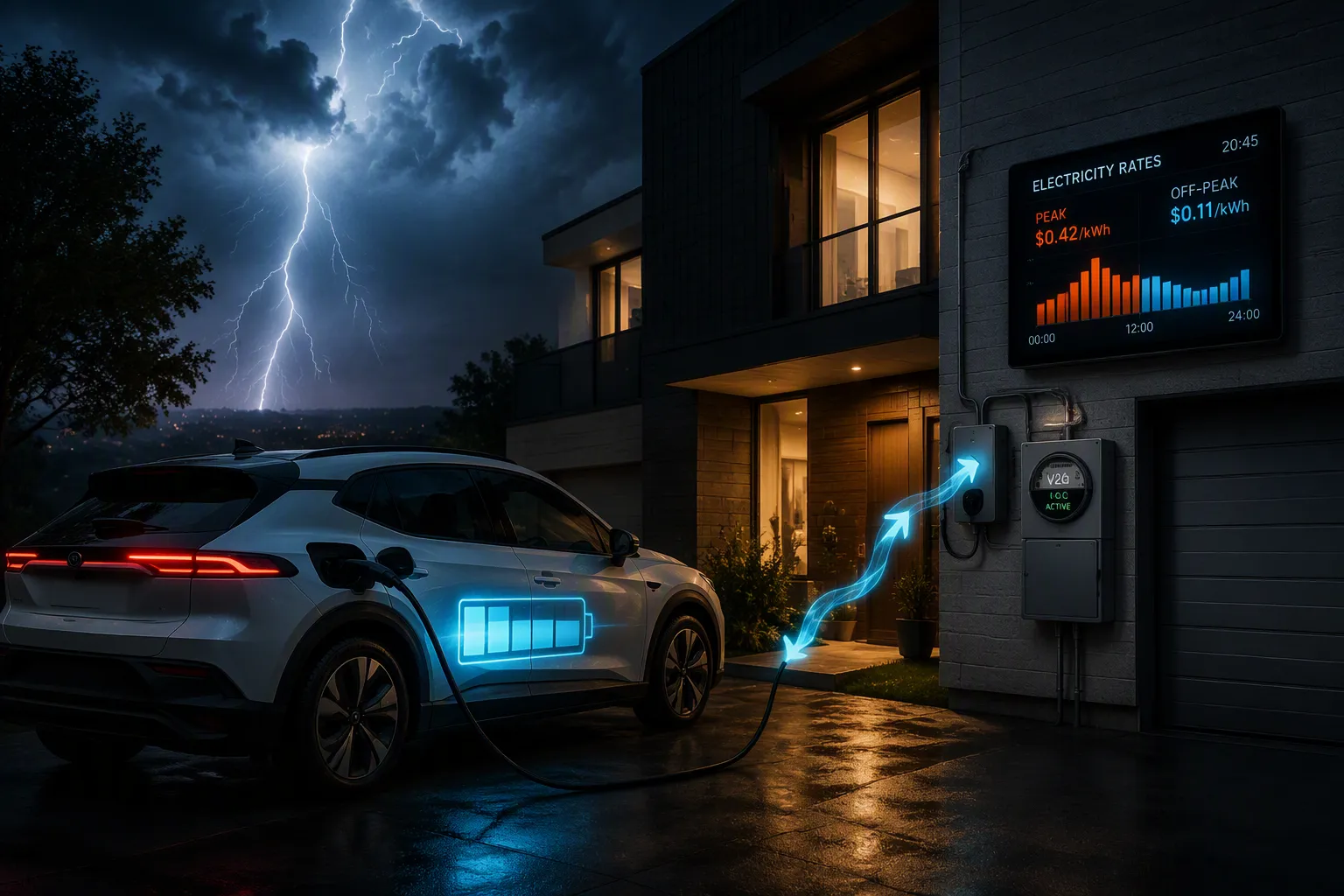
V2H and V2B architectures allow a compatible EV battery to participate in a home or building energy system. Potential applications include backup power, peak-load management, integration with local renewable generation, and time-based energy management.
From the vehicle manufacturer's perspective, these functions become relevant when the target vehicle is expected to interact with a compatible energy-management ecosystem. A bidirectional OBC may provide the vehicle-side conversion capability, but additional system elements can include:
Compatible bidirectional EVSE or power-export equipment
Vehicle and EVSE communication
Building transfer or isolation equipment where required
Energy-management controller
Electrical protection
Local installation and electrical-code compliance
For this reason, it is safer and technically more accurate to say that a bidirectional OBC supports V2H architecture rather than saying the OBC by itself "powers the home."
V2H functionality may add meaningful product value when a vehicle is being developed for markets where backup energy, residential energy management, or renewable-energy integration is an important customer requirement.
However, the OEM should confirm the intended ecosystem early. Designing a bidirectional power stage without defining compatible charging equipment, communication, output power, battery reserve requirements, and regional compliance can result in hardware capability that cannot be practically deployed.
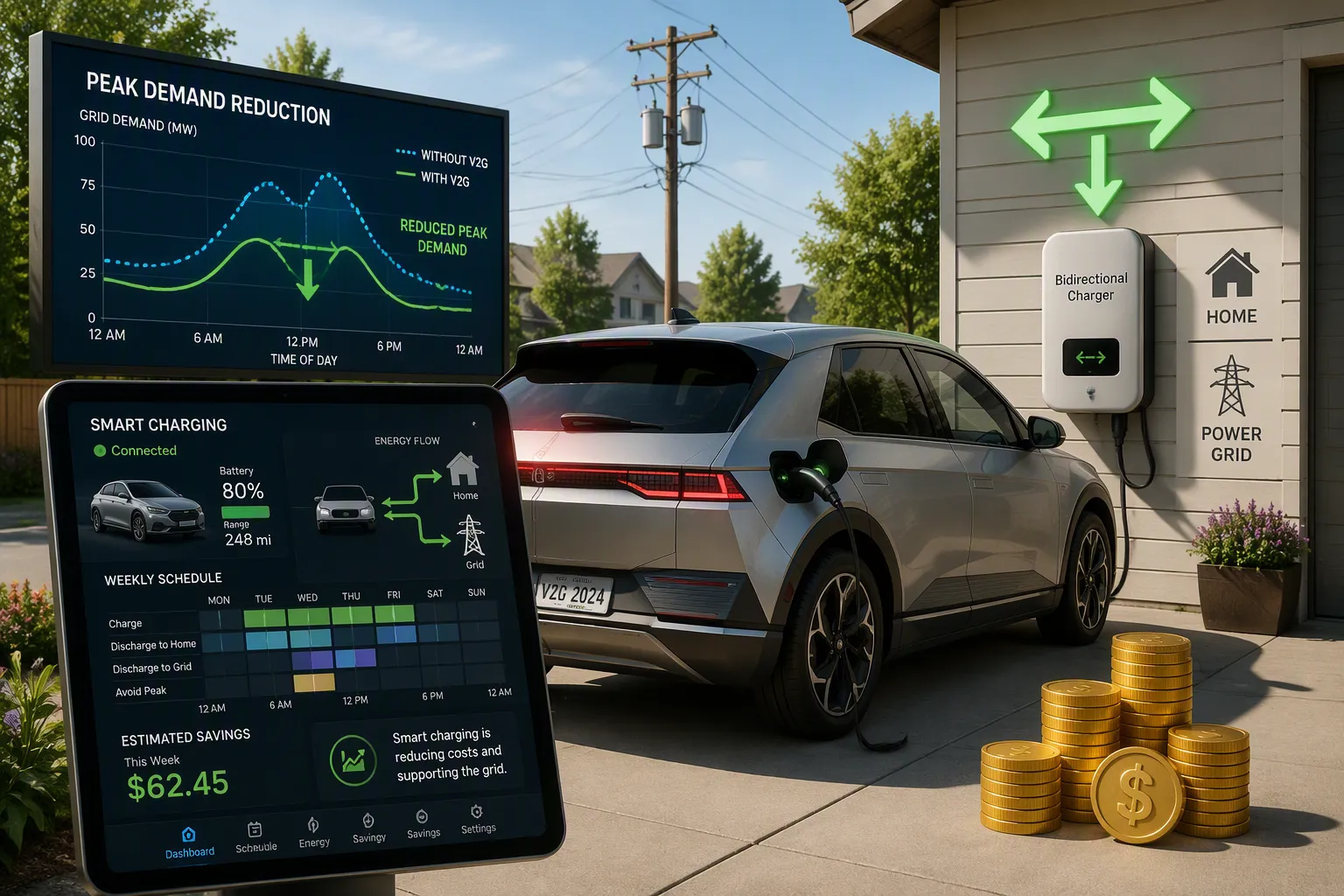
Vehicle-to-grid is more demanding than simple external AC power output because the vehicle participates in an electrical system that operates in parallel with the utility grid.
Potential V2G applications include:
Managed fleet charging and discharging
Demand-response participation
Peak-load management
Distributed-energy-resource aggregation
Grid-support services where permitted
The commercial value of these functions depends heavily on local electricity-market rules, utility programs, metering, aggregation, vehicle availability, and energy prices. For this reason, an OEM should not assume that every V2G-capable vehicle will automatically generate revenue for its owner or fleet operator.
A bidirectional OBC provides an important vehicle-side power-conversion function, but grid-connected operation may also require:
System Area | Potential Requirement |
|---|---|
Vehicle power electronics | Bidirectional AC/DC conversion, protection, monitoring, controlled output |
BMS / VCU | Discharge authorization, SOC limits, battery protection, power commands |
EV–EVSE communication | Required communication architecture for bidirectional charging functions |
EVSE / interconnection equipment | Compatible bidirectional operation, protection, authorization, grid interface |
Grid connection | Applicable utility and interconnection requirements |
Energy-management system | Charging/discharging schedule, vehicle availability, SOC reserve, fleet optimization |
ISO 15118 should not be described simply as a universal "V2G certification." It is a family of standards covering communication between the EV and EVSE.
ISO 15118-20 specifically defines communication messages and sequence requirements that support bidirectional power transfer. For a vehicle program that intends to implement compatible smart or bidirectional charging, the OEM should define which ISO 15118 functions and implementation scope are required.
Grid-interactive AC architectures also need to consider regional interconnection requirements. In North America, for example, SAE J3072 addresses onboard grid-support inverter systems integrated into plug-in electric vehicles and defines relevant EV–EVSE authorization for discharge operation. It is intended to be used together with IEEE 1547 and IEEE 1547.1 requirements.
UL guidance also distinguishes between onboard grid-interactive inverter systems and external EV power-export equipment. This means an OEM should not simply place standards such as SAE J3072, UL 1741, IEEE 1547, and ISO 15118 into one checklist and assume they all apply directly to the OBC component in the same way.
Instead, define:
Target market
AC or DC bidirectional architecture
Vehicle-side inverter/OBC responsibility
EVSE/interconnection-equipment responsibility
Communication requirements
Required safety and grid-certification strategy
Bidirectional power rating should be selected from the required use case rather than assumed to equal the maximum possible vehicle charging rate.
Application | Power Selection Question |
|---|---|
V2L | What external load must the vehicle support continuously and at peak? |
V2H / V2B | What building loads or energy-management functions are expected? |
V2G | What grid-service power and discharge duration are required? |
Fleet energy management | How many vehicles will participate and how much aggregate capacity is needed? |
Commercial/off-road auxiliary power | What equipment load, duty cycle, and environment must be supported? |
Increasing bidirectional power can affect semiconductor sizing, magnetics, thermal design, package size, cooling-system requirements, connector design, and cost. It should therefore be treated as a vehicle-system engineering trade-off.
For a higher-power commercial EV example, see Landworld's 44 kW bidirectional OBC for electric trucks.
Bidirectional charging introduces additional battery energy throughput, so battery-aging impact should be considered during vehicle development. However, there is no single percentage that accurately represents the effect of V2G or V2H across every EV battery.
Battery degradation depends on factors including:
Cell chemistry
Battery temperature
State-of-charge window
Depth of discharge
Charge/discharge power
Cycle frequency
Calendar aging
Vehicle thermal management
For this reason, claims such as "V2G causes only 9–14% additional capacity loss over ten years" should not be treated as a universal engineering assumption. Such values depend strongly on the study conditions and battery-management strategy.
A vehicle intended for frequent bidirectional operation should define an energy-management strategy that protects minimum driving range and avoids unnecessary battery stress.
The BMS and VCU may control:
Minimum discharge SOC
Maximum SOC for long-duration parking
Maximum bidirectional power
Battery temperature limits
Maximum discharge duration
Driving-energy reserve
Fault and degradation protection
The vehicle warranty and durability target should therefore be designed around the intended bidirectional use case rather than leaving V2G or V2H behavior uncontrolled.
Bidirectional operation requires the power stage to perform efficiently in both conversion directions. Forward charging efficiency alone is not enough to evaluate a bidirectional OBC.
Engineering teams should evaluate:
AC-to-DC efficiency during charging
DC-to-AC efficiency during power export
Efficiency across representative load points
Battery-voltage operating range
AC input/output conditions
Continuous bidirectional operating time
Coolant or airflow requirements
Thermal derating behavior
Landworld provides additional background on OBC efficiency in its article explaining how efficient an on-board charger can be.
Not every EV platform needs bidirectional functionality. A conventional OBC may remain the better engineering choice when:
The vehicle only requires AC battery charging.
No defined V2L, V2H, V2G, or power-export use case exists.
Target-market charging infrastructure does not support the intended bidirectional architecture.
Vehicle cost and package space are more important than future power-export capability.
The additional validation, communication, safety, and homologation requirements cannot be justified by the expected customer value.
Bidirectional capability should therefore be treated as a product requirement with a clear use case—not simply as a feature to add to the OBC specification.
Landworld Technology develops on-board power supply solutions for electric vehicles, including conventional OBCs, bidirectional OBCs, DC/DC converters, and integrated charging systems.
The company's on-board charger portfolio includes bidirectional solutions across different power levels for passenger, commercial, off-road, and specialized EV applications.
For passenger vehicle applications, Landworld has also evaluated bidirectional OBC performance in electric passenger vehicles.
When contacting an OBC supplier, define the intended bidirectional use case from the beginning. Useful project information includes:
Requirement | Information to Provide |
|---|---|
Application | V2L, V2H, V2B, V2G, fleet energy management, or other power-export use |
Battery system | Nominal, minimum, and maximum battery voltage; battery capacity |
Charging power | Required forward AC charging power |
Discharge power | Required continuous and peak reverse power |
AC architecture | Voltage, frequency, phase configuration, export requirements |
Communication | CAN, BMS/VCU interface, EV–EVSE communication requirements |
Thermal conditions | Cooling method, ambient range, coolant conditions, duty cycle |
Mechanical constraints | Size, weight, mounting, connectors, IP/environmental requirements |
Target market | Countries/regions and applicable bidirectional charging architecture |
Landworld operates under an IATF 16949-certified automotive quality management system. For projects with functional safety requirements, ISO 26262-related development and validation can be addressed according to the specific product and project scope.
To evaluate a project, review Landworld's on-board charger solutions, learn more about the company, or contact Landworld with your vehicle and bidirectional charging requirements.
For passenger-car programs, you can also review Landworld's electric passenger car solutions.
A bidirectional OBC should be used when the vehicle platform has a clear requirement to export energy as well as receive it. V2L can support external equipment and mobile-power applications, V2H/V2B can connect the vehicle to compatible building energy systems, and V2G can allow the vehicle to participate in grid-interactive energy architectures where infrastructure and regulations permit.
However, these functions should not be attributed to the OBC alone. Successful bidirectional charging depends on the complete system, including the battery, BMS, VCU, EVSE, communication, protection, thermal design, grid interface, and regional compliance strategy.
For EV OEMs and vehicle integrators, the right question is therefore not simply "Do we need a bidirectional charger?" It is: "What power-export function must this vehicle perform, under what operating conditions, and what system architecture is required to support it reliably?"
No. A bidirectional OBC provides vehicle-side power-conversion capability, but V2G also requires compatible vehicle controls, EVSE, communication, grid-interconnection functions, and regulatory approval. Bidirectional hardware alone does not guarantee V2G operation.
V2L supplies external electrical loads, V2H uses vehicle energy within a compatible home energy system, and V2G allows the vehicle to interact with the utility grid. The technical and regulatory requirements become progressively more complex as the vehicle moves from isolated loads toward grid-parallel operation.
Not by itself. ISO 15118 defines communication between the EV and EVSE, and ISO 15118-20 includes communication requirements supporting bidirectional power transfer. The vehicle still requires suitable bidirectional power electronics, control, EVSE compatibility, protection, and any applicable grid-interconnection compliance.
Additional energy throughput can contribute to battery aging, but the actual effect depends on battery chemistry, temperature, depth of discharge, SOC window, discharge power, cycle frequency, and energy-management strategy. It is not accurate to apply one degradation percentage to every vehicle or V2G program.
It can provide vehicle-side reverse power-conversion capability for a compatible V2H or backup-power architecture. However, actual backup operation also requires appropriate external equipment, isolation or transfer functions where applicable, vehicle control, and local electrical-code compliance.
Choose bidirectional capability when V2L, V2H/V2B, V2G, fleet energy management, or another defined power-export use case creates enough customer or operational value to justify the additional hardware, software, thermal, validation, and compliance requirements.
Landworld develops bidirectional OBC and integrated power solutions for different EV applications. Vehicle manufacturers can provide battery voltage, forward and reverse power requirements, AC input/output conditions, communication, cooling, package constraints, target market, and intended V2X use case for technical evaluation.


