
close
Choose Your Site
Global
Social Media


Views: 0 Author: Site Editor Publish Time: 2026-08-28 Origin: Site


Choosing an EV on-board charger (OBC) is a vehicle-system engineering decision rather than simply selecting the highest available charging power. The OBC is installed inside the vehicle and converts AC power from the charging source into controlled DC power for the high-voltage battery. Its power rating, AC input configuration, DC output voltage range, efficiency, thermal design, communication interface, packaging, and safety requirements all need to match the vehicle platform.
For EV manufacturers, commercial vehicle developers, and system integrators, the right on-board charger should balance charging time, battery architecture, target-market charging infrastructure, available installation space, cooling capability, cost, and long-term reliability. A 6.6 kW OBC may be appropriate for one platform, while an 11 kW, 22 kW, or integrated OBC/DC-DC system may be more suitable for another.
This guide explains how to define the key OBC specifications before supplier selection and RFQ, helping engineering and procurement teams choose an on-board charger that fits the complete vehicle architecture rather than focusing on power rating alone.
Select OBC power according to battery capacity, target AC charging time, vehicle duty cycle, and available charging infrastructure.
Confirm AC input voltage and phase configuration together with the required DC output voltage range before choosing an OBC.
Evaluate thermal management, efficiency, packaging, IP protection, communication, diagnostics, and safety requirements at vehicle-system level.
Consider whether the vehicle requires advanced charging functions or OBC technologies from established manufacturers, including integrated or bidirectional architectures.
Provide the supplier with a clear technical specification or RFQ so the OBC can be matched to the vehicle rather than selected only by nominal kW rating.

Before comparing OBC power ratings, it is important to distinguish an on-board charger from external charging equipment. The OBC is a power conversion unit installed in the EV, while EVSE provides AC power and charging communication from outside the vehicle. You can review the difference in more detail in this guide to on-board vs. off-board EV charging.
During AC charging, the charging station may be capable of supplying more power than the vehicle can accept. In this situation, the OBC remains one of the primary limits on AC charging power. For example, connecting a vehicle equipped with a 7 kW-class OBC to a compatible 22 kW AC charging point does not make the vehicle charge at 22 kW. The vehicle will charge only within the limits of its OBC, battery, thermal conditions, charging protocol, and control strategy.
Common EV OBC power levels include approximately 3.3 kW, 6.6 kW, 7 kW, 11 kW, and 22 kW, with higher-power solutions available for specific commercial and specialized vehicle applications. The correct rating depends on how much energy needs to be returned to the battery within the available charging window.
OBC Power Level | Typical AC Architecture | Potential Vehicle Application | Selection Consideration |
|---|---|---|---|
3.3 kW | Single-phase | Smaller battery platforms and specialized EVs | Lower charging power with relatively simple thermal requirements |
6.6 kW / 7 kW class | Commonly single-phase | Passenger EVs, light commercial vehicles, utility EVs | Balances charging speed, cost, packaging, and infrastructure compatibility |
Commonly three-phase in 400 V-class AC markets | Passenger EVs, fleets, commercial vehicle platforms | Useful where faster AC turnaround and compatible three-phase infrastructure are available | |
22 kW | Typically three-phase | Larger-battery or high-utilization vehicle programs | Requires greater attention to thermal management, packaging, and vehicle electrical architecture |
Higher OBC power is not automatically better. Increasing charging power can affect component cost, mass, packaging volume, cooling demand, electromagnetic compatibility, and system complexity. The preferred solution is therefore the power level that satisfies the vehicle's required charging window without creating unnecessary system overhead.
A useful first-stage estimate is:
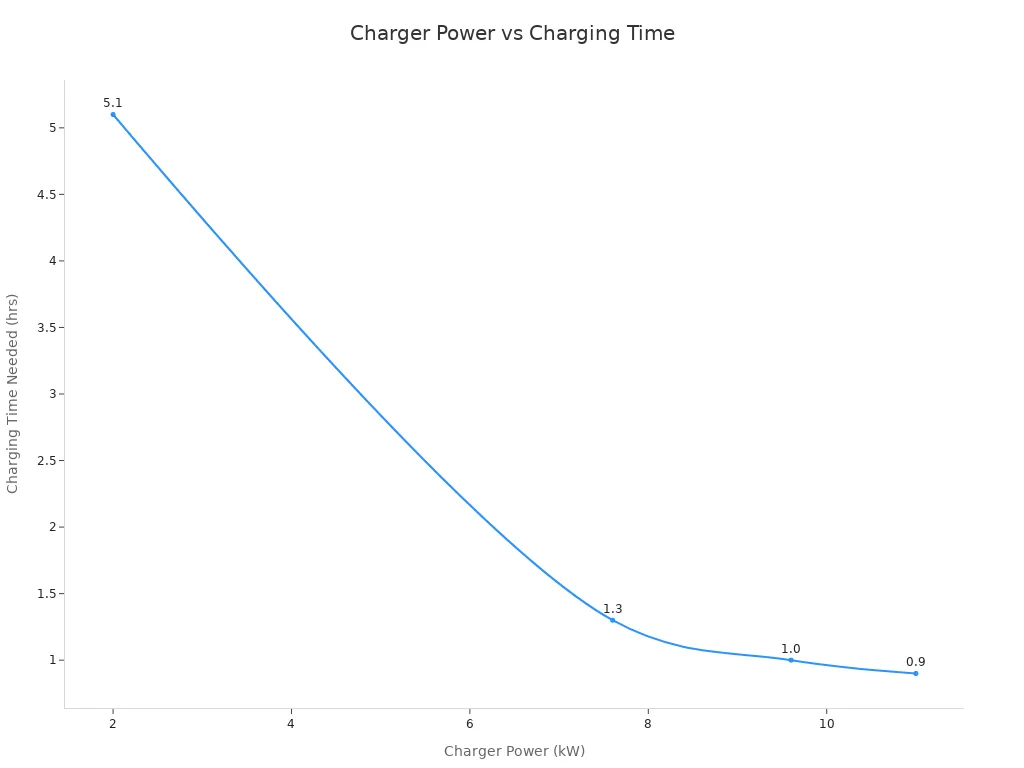
Approximate AC charging time = energy required by the battery ÷ effective charging power.
For example, if approximately 50 kWh needs to be delivered to a battery, an idealized calculation gives about 7.6 hours at 6.6 kW and 4.5 hours at 11 kW. Actual charging time will be longer or different because OBC efficiency, battery temperature, state of charge, battery-management limits, auxiliary loads, supply conditions, and charging-control strategy all affect the effective power delivered to the battery.
OBC selection cannot be made from charging power alone. The charger's DC output must match the operating voltage window of the traction battery. Vehicle programs may use different high-voltage architectures, and the OBC needs to support the required minimum and maximum battery voltage throughout the charging process.
When preparing specifications, engineering teams should provide the supplier with the nominal battery voltage as well as the full operating voltage range. This allows the OBC manufacturer to evaluate topology, semiconductor selection, efficiency, insulation requirements, thermal behavior, and control strategy under realistic conditions.
Battery capacity determines how much energy may need to be replenished, but duty cycle determines how quickly that energy must be restored. A passenger EV parked overnight may tolerate a longer AC charging window, while a commercial fleet vehicle, shuttle, logistics vehicle, or industrial EV may need faster turnaround between operating shifts.
For this reason, an 11 kW or higher-power OBC may provide meaningful operational value on some vehicle programs even when a lower-power charger could technically recharge the battery. Conversely, installing a higher-power OBC offers little benefit when the target charging infrastructure cannot supply the required AC power.
The target market is an important part of OBC design because available grid voltages, AC phases, connectors, charging standards, and infrastructure differ by region. A charger intended for one market should not automatically be assumed suitable for another.
Single-phase charging is common in many residential and light-duty applications, while three-phase AC charging is widely available in various European and commercial charging environments. An 11 kW OBC is commonly configured for three-phase operation where 400 V-class three-phase charging is available, while lower-power OBCs are frequently designed around single-phase input.
For OEM selection, the important question is not simply "single-phase or three-phase?" It is whether the OBC's supported input-voltage and phase range matches the charging infrastructure of the vehicle's intended markets.
Heat generated by power conversion must be managed within the vehicle's thermal system. Depending on OBC power density, operating environment, installation space, duty cycle, and vehicle architecture, designs may use liquid cooling, air cooling, or another thermal solution.
Rather than specifying a cooling method only from the kW rating, vehicle engineers should consider coolant availability, inlet temperature, flow rate, ambient temperature, mounting position, surrounding heat sources, and worst-case charging duration. This is particularly important for commercial vehicles and specialized EVs operating in demanding environments.
Integrated solutions can also reduce the number of separate power-electronics modules in the vehicle. Landworld provides integrated charging systems that can combine functions such as OBC and DC/DC conversion for suitable vehicle architectures.
Power density matters because vehicle packaging space is limited. Before final OBC selection, define the maximum allowable dimensions, mounting orientation, connector access, weight target, cooling interfaces, and service requirements.
A technically capable OBC may still be unsuitable if it requires extensive redesign of the vehicle package. Providing dimensional constraints early in the RFQ helps the supplier evaluate whether a standard product can be used or whether customization is necessary.
OBC efficiency affects charging losses, heat generation, cooling requirements, and overall vehicle energy performance. However, a single peak-efficiency number does not describe performance across the complete operating range.
Engineering teams should therefore review efficiency at representative combinations of AC input voltage, battery voltage, charging power, and temperature. For additional background, see Landworld's explanation of on-board charger efficiency.
The required protection level depends on where the OBC is installed in the vehicle. Specifications may need to define resistance to dust, water, vibration, mechanical shock, humidity, salt exposure, thermal cycling, and other automotive environmental conditions.
Instead of applying an enclosure rating intended for external charging equipment, the OBC should be evaluated according to its actual vehicle installation location and the environmental validation requirements of the program.
Because the OBC is a high-power switching converter connected to both the grid side and the vehicle high-voltage system, electromagnetic compatibility is a major development consideration. The design also needs appropriate electrical protection for abnormal input conditions, overvoltage, overcurrent, overheating, isolation faults, and other defined failure cases.
The applicable EMC, electrical-safety, and vehicle homologation requirements should be identified according to the target market and vehicle category rather than relying on one universal certification list.
An automotive OBC does not operate independently. It typically exchanges charging commands, status information, fault data, voltage, current, temperature, and diagnostic information with other vehicle controllers.
Before supplier selection, define the required CAN communication architecture, message set, baud rate, wake-up behavior, diagnostics, fault handling, and interfaces with the BMS and VCU. Where necessary, software and protocol customization should be discussed during the development stage.
Required charging communication depends on the vehicle's market, connector system, and charging architecture. Some platforms may require only conventional AC charging functions, while others may need more advanced smart-charging or bidirectional capabilities.
It is therefore useful to distinguish between the OBC itself and the wider EV charging ecosystem. This overview of different EV charging types provides additional context on how AC and DC charging architectures differ.
For some EV platforms, integrating the OBC with a high-voltage-to-low-voltage DC/DC converter can reduce the number of separate modules, simplify packaging, and support more centralized thermal and electrical integration.
However, integration should be evaluated based on the vehicle's required power levels, redundancy strategy, serviceability, packaging, thermal architecture, and cost. Landworld also provides guidance on integrated products such as its 2-in-1 11 kW OBC and 3 kW DC/DC system.
If a vehicle program is intended to support functions such as V2L, V2H, or V2G, bidirectional power conversion may need to be considered at the architecture stage. A bidirectional OBC can provide vehicle-side power-conversion capability for certain bidirectional charging architectures, but the OBC alone does not make a complete V2H or V2G system.
Vehicle controls, BMS strategy, charging equipment, communication protocols, grid-interconnection requirements, protection devices, and regional regulations may all be involved. Bidirectional capability should therefore be specified as a complete vehicle and charging-system requirement.
A production EV OBC operates under repeated electrical, thermal, and mechanical stress throughout the vehicle lifecycle. Supplier evaluation should therefore include more than nominal specifications. Ask how the OBC is validated for temperature cycling, vibration, humidity, electrical stress, EMC, insulation, protection functions, and long-duration operation.
Also review the supplier's automotive quality-management capability, traceability process, production testing, change-control process, and support for vehicle-level validation.
For OEM and commercial projects, warranty evaluation should focus on defined operating conditions, failure analysis, claim handling, technical response, spare-product strategy, production lifecycle, and engineering support rather than simply comparing the number of warranty years.
The supplier should also be able to support technical questions during prototype integration, validation, pilot production, and mass production.
Landworld Technology develops automotive power-electronics solutions for electric vehicle platforms, including stand-alone OBCs, DC/DC converters, and integrated charging systems. Its on-board charger portfolio covers multiple power levels and vehicle applications.
For engineering teams comparing available configurations, Landworld also provides a dedicated On-Board Charger product category with solutions for different vehicle power architectures.
Rather than selecting an OBC only from a catalogue power rating, customers can evaluate input voltage, output voltage, communication, cooling, mechanical packaging, environmental requirements, and vehicle application together with the supplier.
The right OBC is the one that fits the battery, vehicle architecture, charging environment, thermal system, and production requirements as one complete system.
Vehicle programs frequently require differences in connectors, CAN communication, firmware logic, mechanical interfaces, cooling, input/output voltage range, and protection strategy. A supplier with in-house development capability can respond more effectively when a standard product needs to be adapted to a specific vehicle platform.
Landworld develops power-electronics technologies for EV applications and offers modular and integrated charging solutions for different system requirements.
You can learn more about Landworld's company and manufacturing capabilities before starting a technical evaluation.
A clear initial specification allows an OBC supplier to identify a suitable product more quickly and reduces unnecessary technical iterations. At minimum, an EV OBC inquiry should provide the following information:
Specification Area | Information to Provide | Why It Matters |
|---|---|---|
Vehicle application | Passenger EV, commercial EV, off-road EV, specialized vehicle, etc. | Defines operating environment and duty cycle |
Battery system | Nominal voltage, minimum/maximum voltage, battery capacity | Determines required DC output range and charging profile |
Charging power | Required OBC rated power and target charging time | Defines power-conversion requirement |
AC input | Voltage, frequency, single-/three-phase requirements | Ensures compatibility with target charging markets |
Thermal system | Cooling method, coolant conditions, ambient temperature | Affects continuous power and reliability |
Communication | CAN, BMS/VCU interface, diagnostics, charging protocol | Required for vehicle integration |
Mechanical constraints | Maximum size, weight, mounting position, connector requirements | Determines packaging feasibility |
Project requirement | Prototype quantity, annual volume, SOP timing, target market | Supports commercial and production planning |
Once these parameters are clear, you can compare suitable Landworld EV on-board chargers or contact the Landworld engineering team to discuss a vehicle-specific OBC requirement.
Choosing an EV on-board charger requires more than comparing 6.6 kW, 11 kW, or 22 kW ratings. The OBC must be selected as part of the complete vehicle electrical architecture. Battery voltage and capacity, AC input conditions, target charging time, vehicle duty cycle, cooling, packaging, communication, safety, environmental protection, and production requirements all influence the final choice.
For EV OEMs and vehicle integrators, defining these parameters before supplier selection helps avoid oversizing, compatibility issues, thermal problems, packaging conflicts, and unnecessary development changes. If you are still comparing possible specifications, Landworld's on-board charger FAQ provides additional technical information for EV charging-system evaluation.
Yes, provided the charging connector, communication, voltage, and other system requirements are compatible. However, the vehicle will not charge at 22 kW. Its actual AC charging power will be limited by the OBC's approximately 7 kW capability together with battery, thermal, supply, and control limits. A higher-rated AC charging point cannot force the vehicle's OBC to accept more power than it is designed for.
An 11 kW OBC is commonly configured for three-phase AC operation in markets using approximately 400 V three-phase charging infrastructure. However, the exact input architecture depends on the OBC design and target market. Always confirm supported AC voltage, frequency, phase configuration, and current limits from the supplier's technical specification.
Compare the battery capacity, required AC charging time, target-market grid architecture, vehicle duty cycle, thermal system, packaging space, and system cost. A 6.6 kW OBC may be sufficient where overnight charging is available, while an 11 kW OBC can reduce AC charging time when compatible three-phase infrastructure is available and faster vehicle turnaround is valuable.
At minimum, provide battery nominal and operating voltage, required charging power, AC input requirements, target vehicle application, cooling conditions, communication interface, installation space, environmental requirements, and expected project volume. More complete vehicle information allows the supplier to make a more accurate recommendation.
An integrated system can be useful when the vehicle program needs both high-voltage battery charging and low-voltage DC power conversion and when integration benefits packaging, wiring, thermal management, or system cost. The final decision should consider serviceability, redundancy, power requirements, thermal architecture, and vehicle-level design constraints.
No. A higher-power OBC may reduce AC charging time, but it can also increase cost, cooling demand, packaging requirements, and system complexity. If the target charging infrastructure cannot provide the additional AC power, the higher rating may offer little practical benefit. The best OBC is the one sized for the vehicle's actual charging and operating requirements.


