
close
Choose Your Site
Global
Social Media


Views: 0 Author: Site Editor Publish Time: 2026-09-09 Origin: Site


A well-prepared EV on-board charger RFQ should give the supplier enough information to determine whether an existing OBC can meet the vehicle program requirements or whether hardware, software, mechanical, or communication customization is needed. At minimum, the RFQ should define the vehicle application, battery system, AC input, required charging power, thermal conditions, mechanical constraints, communication interfaces, environmental requirements, validation expectations, project timing, and expected production volume.
The objective is not to fill the RFQ with as many fixed numbers as possible. It is to clearly distinguish mandatory requirements from preferred targets and allowable ranges. This gives engineering teams room to compare technically appropriate solutions without creating unnecessary design constraints.
The following checklist explains the most important information EV OEMs, commercial vehicle developers, and system integrators should prepare before requesting an OBC quotation.
Define battery nominal voltage, minimum and maximum charging voltage, required OBC power, and AC input conditions before asking for a quotation.
Specify efficiency and power-quality targets across relevant operating points instead of relying only on one peak-efficiency number.
Define packaging, cooling, IP protection, vibration, and temperature requirements according to the actual vehicle installation environment rather than applying one fixed requirement to every project.
Separate internal vehicle communication from EV–EVSE communication. CAN is commonly used between the OBC, BMS, and VCU, while standards such as ISO 15118 should be specified only when required by the vehicle's charging architecture and target market.
Evaluate supplier engineering capability, automotive quality systems, validation support, production capacity, change control, and lifecycle support in addition to unit price.
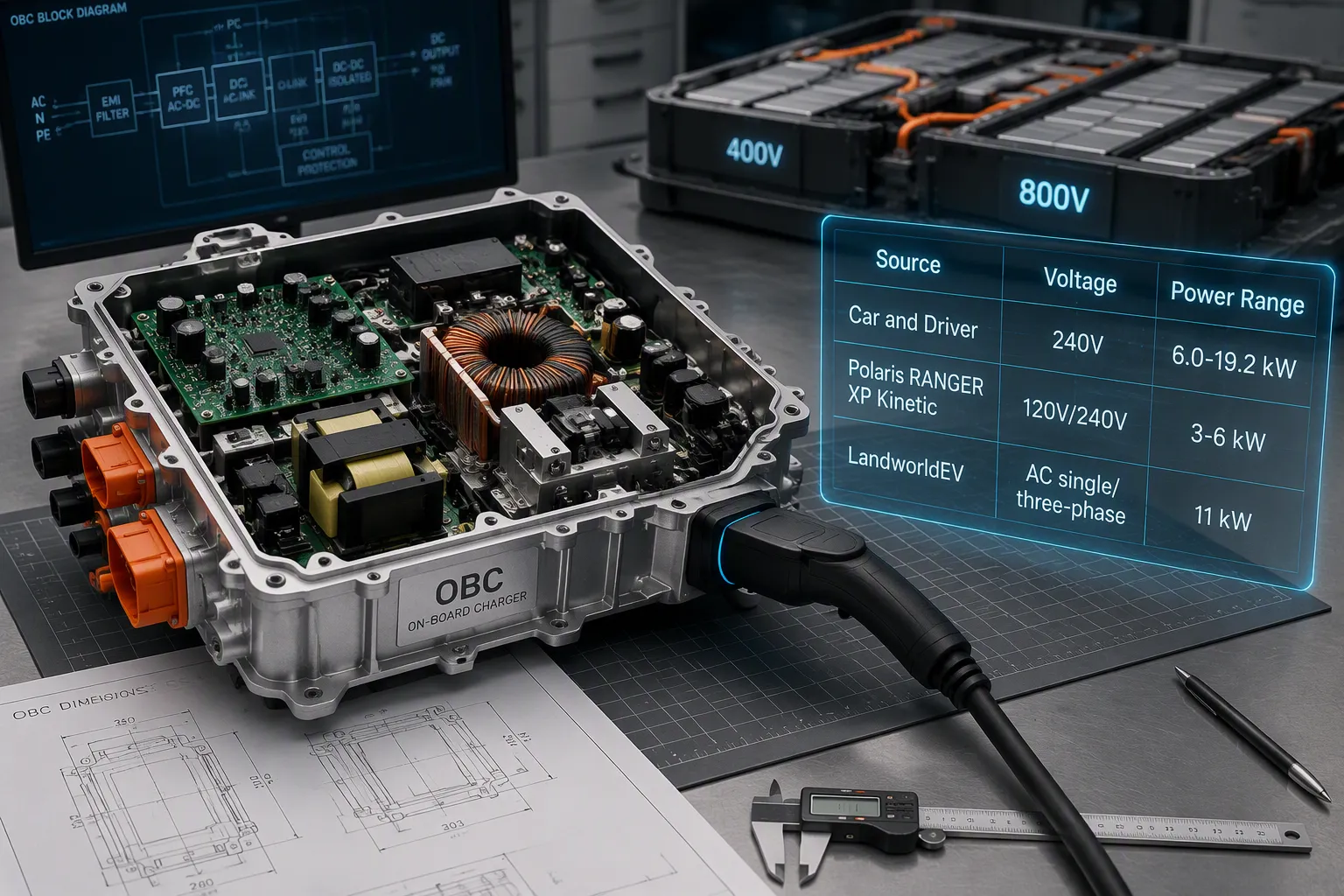
Electrical requirements are the starting point of an EV OBC RFQ. The supplier needs to understand both the AC charging environment and the high-voltage battery system. Simply requesting an "11 kW charger" is not enough to determine compatibility.
Start with the required continuous charging power and the vehicle's target AC charging time. Common OBC power classes include 3.3 kW, 6.6 kW, 11 kW, 13 kW, 20 kW, 22 kW, and higher-power configurations for selected commercial and specialized EV applications.
The appropriate rating depends on battery capacity, vehicle duty cycle, target charging window, available AC infrastructure, thermal architecture, package space, and cost. For example, an 11 kW OBC may be appropriate when faster AC turnaround and compatible three-phase infrastructure are available, while a lower-power unit may be sufficient for a vehicle that has a long overnight charging window.
RFQ Item | Information to Provide | Why It Matters |
|---|---|---|
Rated OBC power | Required continuous power and acceptable alternatives | Determines charging time, heat generation, packaging, and cost |
Target charging time | Required energy recovery within a specified time window | Helps prevent unnecessary OBC oversizing |
Duty cycle | Passenger EV, fleet vehicle, logistics EV, off-road vehicle, etc. | Changes continuous-power and thermal requirements |
The RFQ should state the battery's nominal voltage together with the minimum and maximum voltage expected during charging. Referring to the battery simply as a "400 V system" or "800 V system" is not precise enough for supplier evaluation because actual operating windows can vary substantially by battery chemistry, pack configuration, state of charge, and vehicle design.
The supplier needs the complete DC output requirement to evaluate topology, semiconductor voltage rating, insulation design, control range, efficiency, and thermal performance.
Recommended RFQ fields include:
Battery nominal voltage
Minimum battery charging voltage
Maximum battery charging voltage
Maximum required charging current
Required voltage/current control accuracy
Charging profile or relevant BMS control requirements
The RFQ must also define the AC charging conditions expected in the vehicle's target markets. This includes input-voltage range, frequency, phase configuration, maximum current, and any required derating behavior.
Input Requirement | What to Define |
|---|---|
AC voltage | Nominal input and allowable minimum/maximum range |
Frequency | Required operating frequency, commonly including 50 Hz and/or 60 Hz depending on market |
Phase configuration | Single-phase, three-phase, or multi-market capability |
Maximum AC current | Required current limit under each supported input condition |
Abnormal input behavior | Undervoltage, overvoltage, frequency deviation, restart, and fault response |
Do not assume that one fixed relationship between OBC power and phase configuration applies globally. For example, 11 kW charging is commonly associated with three-phase AC in markets using 400 V-class three-phase infrastructure, but the exact supported input architecture must always be confirmed from the specific OBC design.
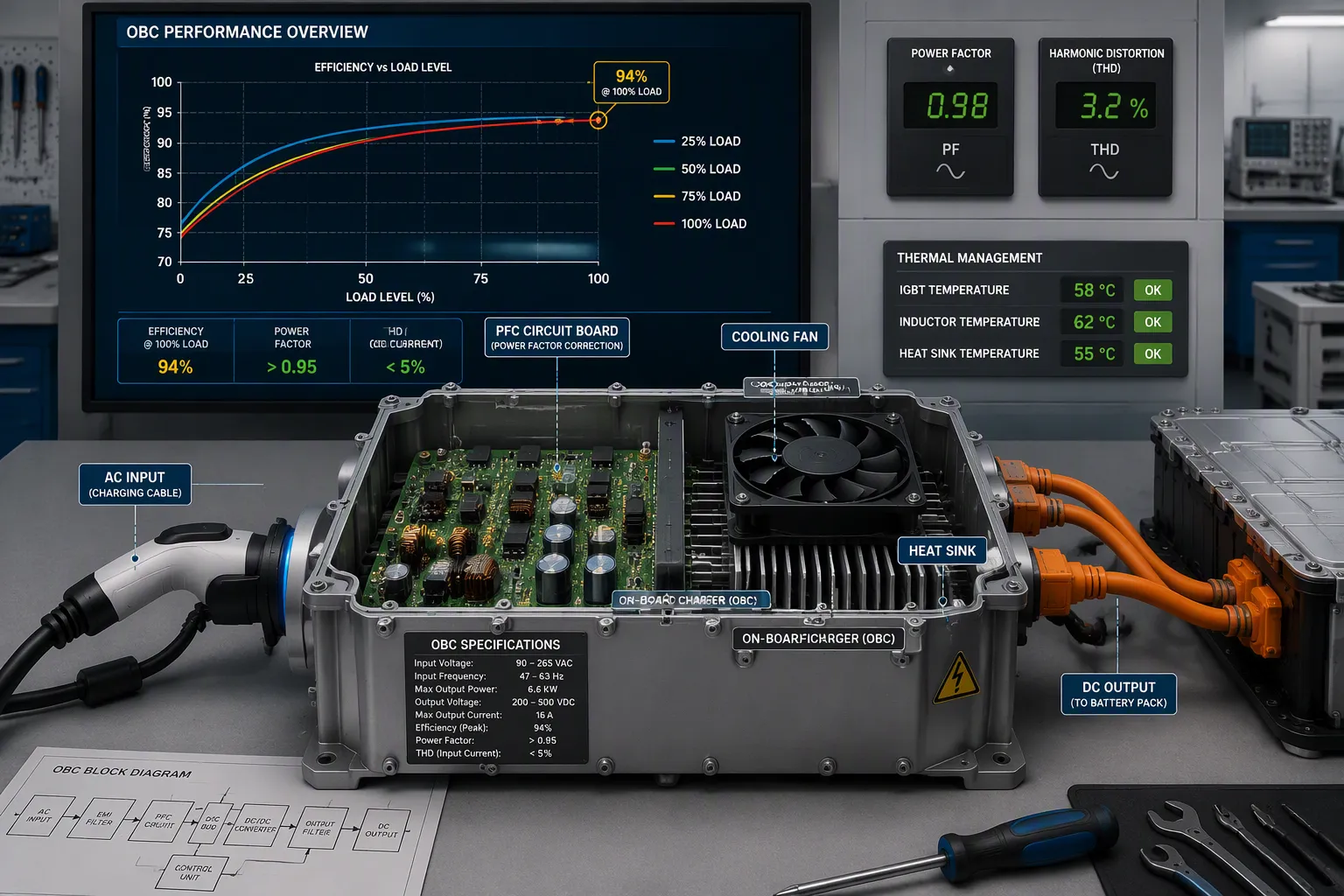
OBC efficiency affects energy losses, thermal load, coolant demand, component stress, and vehicle-level charging performance. However, an RFQ should not define performance only through a single peak-efficiency figure.
Landworld discusses this relationship in more detail in its article on how OBC efficiency impacts EV energy consumption.
Instead of simply writing "efficiency must exceed 95%," define how efficiency will be evaluated. Depending on the project, this may include minimum or target efficiency at representative combinations of AC input voltage, battery voltage, output power, and temperature.
Useful RFQ requirements may include:
Target peak efficiency
Minimum efficiency at selected load points
Efficiency under minimum and maximum battery voltage
Efficiency under representative AC input conditions
Measurement conditions and tolerances
This provides a much clearer picture of real OBC performance than one headline number. Additional background is available in Landworld's guide to on-board charger efficiency.
The RFQ should also identify applicable power-quality requirements, including power factor, input-current harmonics, and electromagnetic compatibility. The required limits should be based on the target markets, input power, and applicable standards rather than copied from a generic OBC specification.
Where necessary, state:
Required power factor at defined operating points
Applicable harmonic-current limits
EMI/EMC standards and test levels
Conditions under which performance is measured
There is no universal rule that every OBC above a particular power rating must use liquid cooling. Cooling should be selected according to power loss, power density, package volume, ambient conditions, vehicle duty cycle, installation location, and the vehicle's existing thermal architecture.
Liquid cooling is common in higher-power and high-power-density automotive OBC applications because it can integrate with the vehicle thermal loop. Air-cooled solutions may still be suitable for certain vehicle classes and operating environments.
If the proposed OBC uses liquid cooling, the RFQ should define or request agreement on:
Thermal Parameter | RFQ Requirement |
|---|---|
Coolant | Vehicle-approved coolant type and concentration |
Coolant inlet temperature | Normal and worst-case operating range |
Flow rate | Available vehicle-side range or supplier requirement |
Pressure drop | Maximum acceptable value at defined flow |
Cooling interface | Port dimensions, orientation, and connection requirements |
The RFQ should define what happens when ambient temperature, coolant temperature, component temperature, or another thermal parameter exceeds the full-power operating range.
Ask the supplier to provide the continuous-power envelope and derating curve rather than relying only on the absolute maximum semiconductor junction-temperature rating. Component maximum ratings are design limits, not recommended normal operating targets.
The vehicle engineering team should understand when the OBC begins reducing power, how the reduction is controlled, how thermal faults are reported, and under what conditions normal charging resumes.
Packaging requirements should come directly from the vehicle architecture. Avoid specifying generic assumptions such as "an OBC should weigh 8–15 kg" because the acceptable size and mass differ substantially between passenger vehicles, commercial vehicles, construction equipment, off-road EVs, and integrated power systems.
Instead, provide a maximum mechanical envelope and installation constraints.
Mechanical RFQ Item | Information to Define |
|---|---|
Maximum dimensions | Length × width × height envelope |
Maximum weight | Vehicle packaging target |
Mounting position | Underbody, engine compartment, cabin-protected location, equipment compartment, etc. |
Mounting orientation | Allowed orientations and mounting points |
Electrical connectors | HV AC, HV DC, LV communication, interlock, connector orientation |
Cooling connectors | Location, type, and service access |
Vehicle-mounted power electronics must withstand vibration and mechanical shock appropriate to their installation location. ISO 16750-3 may be relevant to road-vehicle electrical and electronic equipment, while OEM-specific test standards or other validation profiles may also apply.
Your RFQ should identify the vehicle category, installation location, required vibration profile, shock requirement, mounting method, and any customer-specific validation specification. The supplier can then confirm whether an existing product has already been validated under comparable conditions.
Do not automatically require IP67 for every OBC. The necessary ingress protection depends on where the unit is installed and its realistic exposure to water and dust. An underbody or exposed equipment installation may require a higher IP rating than a protected installation inside a sealed vehicle compartment.
The RFQ should define:
Required IP rating
Water-exposure or immersion requirements if applicable
Dust exposure
Humidity and condensation
Salt spray or corrosion conditions if relevant
Chemical exposure if installation conditions require it
Similarly, -40°C to +85°C should not be presented as a universal mandatory OBC operating range. Your RFQ should state the actual vehicle-level operating and storage temperature requirements and distinguish between full-power operation, derated operation, startup capability, and storage survival.
If the project requires -40°C cold-start capability or operation in high-temperature construction or commercial vehicle environments, state this explicitly and ask the supplier to provide corresponding performance limits and validation evidence.
Communication requirements are frequently oversimplified in OBC RFQs. It is important to separate three different communication layers: communication inside the vehicle, communication between the EV and EVSE, and communication between charging infrastructure and backend management systems.
CAN is commonly used for communication between the OBC and vehicle controllers such as the BMS and VCU. The RFQ should define the interface expectations clearly enough for the supplier to estimate software adaptation and integration work.
Include information such as:
CAN baud rate
Message definitions or DBC availability
Charging enable and stop logic
Voltage and current commands
Status messages
Temperature reporting
Fault and diagnostic messages
Wake-up and sleep behavior
UDS or other diagnostic requirements where applicable
Communication Technology | Where It Applies | OBC RFQ Relevance |
|---|---|---|
CAN | Vehicle internal network | Commonly relevant to OBC–BMS–VCU integration |
ISO 15118 | Communication between EV and EVSE | Specify when required by the vehicle charging architecture, market, Plug & Charge, smart charging, or bidirectional functions |
OCPP | Charging station to charging management system/backend | Normally not an OBC requirement |
DC charging communication | Vehicle to off-board DC charger | Relevant to vehicle charging architecture, but DC charging power bypasses the OBC power-conversion stage |
ISO 15118 should therefore not be written as a mandatory requirement for every OBC project. ISO 15118-20, for example, defines EV–EVSE communication and includes communication requirements supporting bidirectional power transfer. Whether it belongs in a specific RFQ depends on the vehicle's charging architecture and target markets.
OCPP should generally not appear as a core OBC protocol requirement because it governs communication between charging stations and charging management systems rather than communication inside the vehicle.
The RFQ should define required protection, diagnostics, and failure-reporting behavior. Typical OBC functions may include protection against overvoltage, undervoltage, overcurrent, overtemperature, insulation faults, communication loss, and abnormal AC input conditions.
Ask the supplier to explain:
Fault detection logic
Fault severity classification
CAN fault reporting
Diagnostic trouble codes
Safe-state behavior
Fault recovery and restart logic
A common RFQ mistake is to copy a long list of charging standards and require the OBC to "comply with all of them." Different standards cover different parts of the vehicle and charging ecosystem. The relevant list should be determined from vehicle type, market, charging interface, system architecture, and homologation strategy.
Depending on the project, areas to consider may include:
Vehicle electrical/electronic environmental requirements
EMC requirements such as applicable CISPR or OEM specifications
Conductive charging requirements
EV–EVSE communication requirements
Electrical safety and isolation requirements
Functional safety requirements
Cybersecurity engineering requirements
Customer-specific validation standards
Do not automatically place standards intended primarily for external EVSE, such as charging-station requirements, into the OBC component specification without confirming their scope.
If the OBC contributes to safety-related vehicle functions, the RFQ should define the project's functional-safety expectations, including required work products, safety interface, safety goals, ASIL assumptions where applicable, and responsibility allocation between vehicle manufacturer and supplier.
Landworld operates under an IATF 16949-certified automotive quality management system. For projects with functional safety requirements, ISO 26262-related development and validation can be addressed according to the specific product and project scope. These organizational capabilities can support OEM projects, but the RFQ should still define the required product- and project-level evidence rather than treating a company-level certification as proof that every individual OBC automatically satisfies every vehicle safety requirement.
Cybersecurity requirements should also be defined according to system architecture and risk analysis. Potential requirements may include authenticated firmware update, secure boot, access control, diagnostic protection, secure communication, key management, and software-update procedures.
Landworld has obtained ISO/SAE 21434 certification, supporting its automotive cybersecurity development and management capabilities. For an actual RFQ, the required cybersecurity deliverables should still be defined according to the specific vehicle architecture and project scope.
A strong EV OBC RFQ should tell the supplier what evidence is needed before design approval, DV/PV completion, and start of production. Avoid asking only whether the product is "automotive grade."
Validation Area | Possible RFQ Requirement |
|---|---|
Electrical performance | Voltage/current accuracy, efficiency, power factor, protection, abnormal-input testing |
Thermal | High/low temperature operation, thermal cycling, derating verification |
Mechanical | Vibration, shock, mounting durability |
Environmental | Humidity, ingress protection, corrosion where applicable |
EMC | Emissions and immunity requirements according to project specification |
Software | Communication, diagnostics, fault recovery, firmware-version control |
Ask whether existing test reports apply to the exact hardware and software version being offered. A general company capability statement should not replace model-specific evidence where validation is critical.
An RFQ is not only a technical document. The supplier also needs enough commercial and program information to determine tooling, engineering effort, validation schedule, manufacturing capacity, and unit pricing.
Include:
Prototype quantity
DV/PV sample quantities if applicable
Expected annual volume
Total expected program volume
Prototype delivery date
Validation milestones
PPAP or equivalent approval timing
Start of production date
Do not assume that every OBC project should require exactly five years or 100,000 miles of warranty coverage. Warranty obligations depend on vehicle category, commercial agreement, operating conditions, market, and OEM program requirements.
Instead, define the required warranty period and ask the supplier to explain:
Lifecycle Requirement | What to Clarify |
|---|---|
Warranty | Time/mileage or operating-hours basis, exclusions, responsibility |
Failure analysis | Response time, 8D or equivalent corrective-action process |
Change management | Notification and approval process for hardware/software changes |
Obsolescence | Component EOL notification and alternative-part management |
Service support | Spare units, technical support, field-return handling |
The following summary can be used as a practical first-stage RFQ checklist.
Category | Information to Include |
|---|---|
Vehicle | Vehicle type, application, target markets, duty cycle |
Battery | Capacity, nominal voltage, minimum voltage, maximum voltage |
OBC output | Rated power, DC voltage/current range, target charging time |
AC input | Voltage range, phase, frequency, current |
Performance | Efficiency, power factor, harmonics, derating |
Thermal | Cooling method, coolant parameters, ambient conditions |
Mechanical | Maximum dimensions, weight, mounting, connectors |
Environment | Temperature, IP, vibration, humidity, corrosion requirements |
Communication | CAN, BMS/VCU interface, diagnostics, EV–EVSE requirements where applicable |
Safety & compliance | Applicable functional safety, EMC, charging, cybersecurity, and OEM standards |
Project | Samples, annual volume, milestones, SOP timing |
Commercial | Target cost, warranty, lifecycle, change-control requirements |
Landworld Technology develops on-board power supply solutions for electric vehicle platforms, including OBCs, DC/DC converters, and integrated power systems. Its current product portfolio covers multiple power levels and system configurations for passenger, commercial, off-road, and specialized electric vehicle applications.
Landworld operates under an IATF 16949-certified automotive quality management system. For projects with functional safety requirements, ISO 26262-related development and validation can be addressed according to the specific product and project scope. The company also states that it holds full intellectual property rights over its high-reliability and high-power-density power-electronics products.
For an OEM program, these capabilities matter because OBC sourcing often involves more than purchasing a standard module. Vehicle teams may require changes to voltage range, CAN communication, connectors, firmware, package dimensions, thermal interfaces, or other system parameters.
You can review Landworld's current on-board charger solutions before submitting an RFQ.
A technically useful OBC supplier should be able to evaluate the complete requirement rather than only matching a customer to the closest catalogue power rating. Landworld provides customizable OBC and DC/DC solutions for different vehicle platforms and works with customers on parameters such as power, voltage, form factor, and vehicle integration.
For additional technical information, visit Landworld's technical FAQ or review the company's engineering and manufacturing background.
When your vehicle specifications are ready, you can contact Landworld and provide the battery voltage range, required OBC power, AC input, communication interface, cooling conditions, package limits, expected annual volume, and project timing for an initial technical evaluation.
A good EV OBC RFQ does more than specify a power rating. It defines the electrical, thermal, mechanical, communication, environmental, validation, safety, production, and lifecycle conditions that the OBC must satisfy inside the vehicle.
The most useful RFQs separate mandatory requirements from preferred targets and allowable alternatives. This gives suppliers enough flexibility to recommend an existing platform where appropriate while clearly identifying areas that require customization.
If you are preparing an EV OBC project, review Landworld's on-board charger range or contact the engineering team with your vehicle specifications for further evaluation.
Start with vehicle application, battery nominal/minimum/maximum voltage, battery capacity, required OBC charging power, AC input voltage and phase, cooling conditions, package limits, CAN communication requirements, target markets, expected annual volume, and project timing. These parameters allow the supplier to determine whether an existing OBC platform is suitable.
A high efficiency target is useful, but one peak number is not enough for an engineering RFQ. Define the operating conditions under which efficiency will be measured and, where necessary, specify targets at representative load, AC input, battery-voltage, and temperature points.
No. Liquid cooling is common for higher-power or high-power-density automotive OBCs, but the correct cooling method depends on power loss, packaging, ambient conditions, duty cycle, and the vehicle thermal architecture. The RFQ should define the available thermal environment instead of applying one cooling rule solely from power rating.
No. ISO 15118 defines communication between the EV and EVSE and is relevant to vehicle architectures requiring associated communication functions such as Plug & Charge, smart charging, or certain bidirectional charging capabilities. Its applicability depends on the charging system and target market.
Normally not as an OBC requirement. OCPP is primarily a communication protocol between charging stations and charging management systems. CAN communication between the OBC, BMS, and VCU is much more directly relevant to an OBC component RFQ.
No. The required ingress-protection level depends on the installation environment. An exposed or underbody installation may require stronger protection than a unit mounted inside a protected enclosure. Specify the vehicle's real environmental requirement instead of automatically requesting IP67.
Landworld offers OBCs and integrated power solutions across multiple power levels and supports customization for different EV architectures. Buyers can review its OBC portfolio and contact the Landworld team with battery, charging, communication, thermal, mechanical, and project requirements.


